
Translated from the gallery’s own Chinese text. Where the two differ, the Chinese is the record.

01The change of the school's name and the completion of the Octagonal Tower

Ever since it opened, Tamsui Middle School had continued to use Oxford College as its school building. That building was limited in size, and the fine buildings of the girls' school had already been rebuilt and put into use, so the construction of new premises became the first task of the boys' middle school. In the spring of 1919 the Japanese government permitted fundraising for this building project, and before long 16,000 Japanese yen had been raised; an application for a grant was also made to Canada.

In February 1922 the Government-General reissued the Taiwan Education Ordinance, which placed many restrictions on private schools: schools that were not official could no longer use the designation "school" (學校). In October the boys' and girls' schools were renamed "Private Tamsui Middle School" (私立淡水中學) and "Private Tamsui Girls' Academy" (私立淡水女學院) respectively.
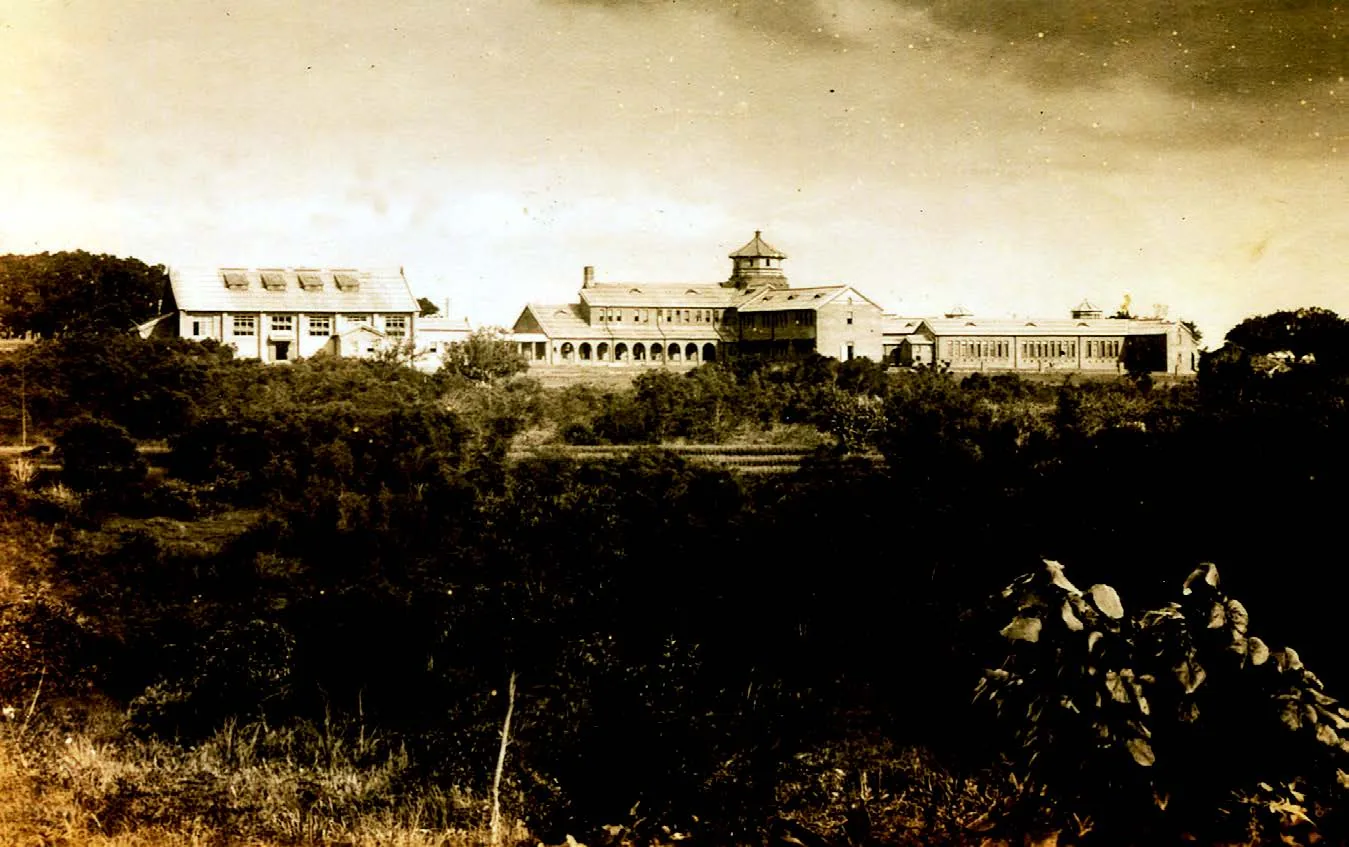
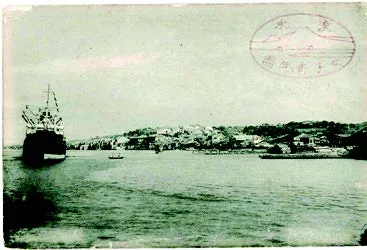
After Japan took possession of Taiwan, Tamsui harbour silted up steadily and was supplanted by Keelung harbour, becoming an international port in name only. The picture shows the harbour in front of today's Tamsui MRT station in the 1930s; the steamer at the left of the photograph is the Taikan Maru (大觀丸) of the Shih Ho-fa Company (施合發商行) of that time.

Once the gymnasium and the Octagonal Tower building were completed and brought into use, the founding era in Oxford College, which had lasted eleven years, came to an end. The hill at Puting (埔頂) thereby became the site of Tamkang Senior High School's campus for the century that followed.

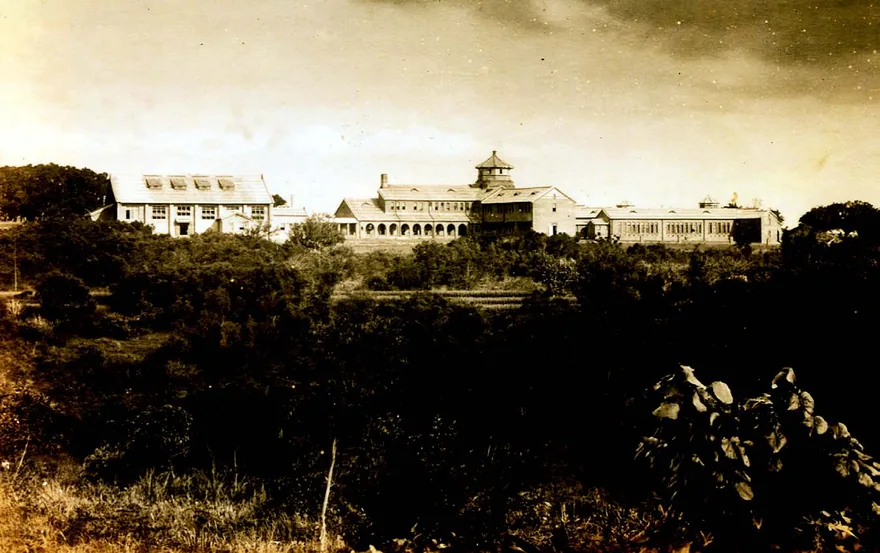
In June 1923 the Mackay Memorial Gymnasium, designed by Mr. Kenneth Dowie, B. Sc. (羅虔益), was completed and opened on the new campus; it had been built first in order to serve as the venue for the assembly marking the fiftieth anniversary of the founding of the church in northern Taiwan. At the end of the same year work began on the new Octagonal Tower building, also designed by Mr. Dowie, which was completed in June 1925.

The students moved from Oxford College, borrowed for eleven years, to the new campus (Oxford College thereafter served as a dormitory for Tamsui Middle School students until 1931), and from then on the Octagonal Tower became the spiritual emblem of the school. At the same time the more than 5,000 ping of land that Dr. Mackay had left to his family was used as the middle school's sports ground, today's rugby ground. New buildings and a new spirit carried Tamsui Middle School into a new era.
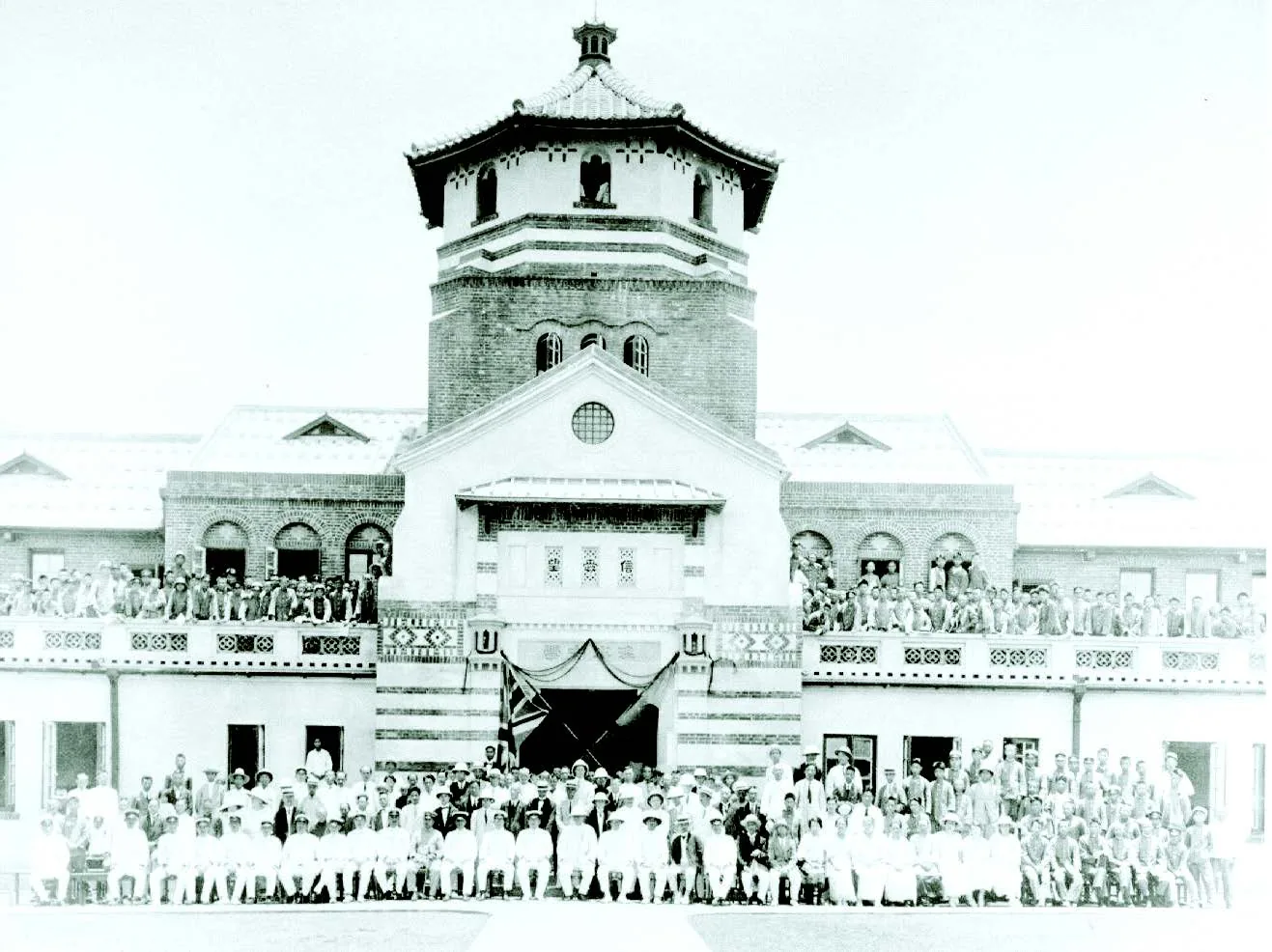
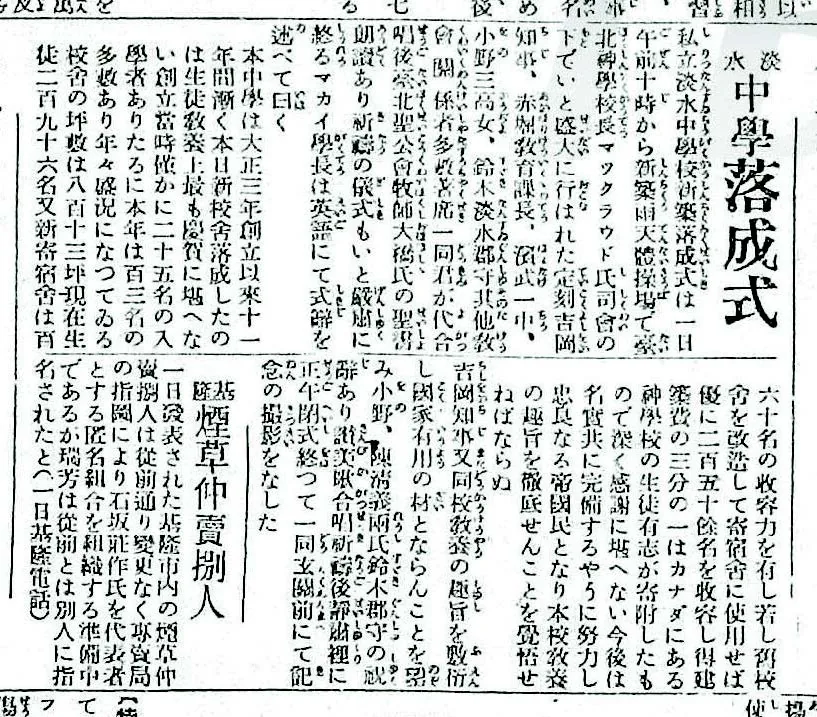
The dedication ceremony of the Octagonal Tower. It was held in the gymnasium at 10 a.m. on 1 July 1925, after which a commemorative group photograph was taken in front of the Octagonal Tower's main entrance.
A newspaper report on the grand occasion of that day's dedication ceremony.

In the summer of 1925 Principal George William Mackay (偕叡廉), who had taught in Taiwanese and English, went to Japan for a year and a half under the pressure of the times in order to learn the national language (Japanese). Unfortunately, this did not win any goodwill in response from the Japanese government. Tamsui Middle School and Tamsui Girls' Academy were founded on a religious spirit, centred on Western humanistic education, took Taiwanese children as their pupils, taught in Taiwanese and also taught the Bible, and so naturally could not be tolerated under the kōminka policy of Japanese militarism.

Although they had good teachers, beautiful grounds and complete facilities, the schools were never able to obtain the Government-General's "filing" (備案) or "recognition" (認定) as accredited middle schools. At a time when educational resources were monopolised by the Japanese, Tamsui Middle School and Tamsui Girls' Academy became a precious channel of education for Taiwanese; but because of the policy restrictions, students of the two schools could not go on to sit the entrance examinations of the higher schools. Therefore, apart from believers' children who wished to enter the theological college, most students studied for two or three years and then moved to Japan to study, so that the graduates at the end of the course often numbered less than a tenth of those who had originally enrolled.
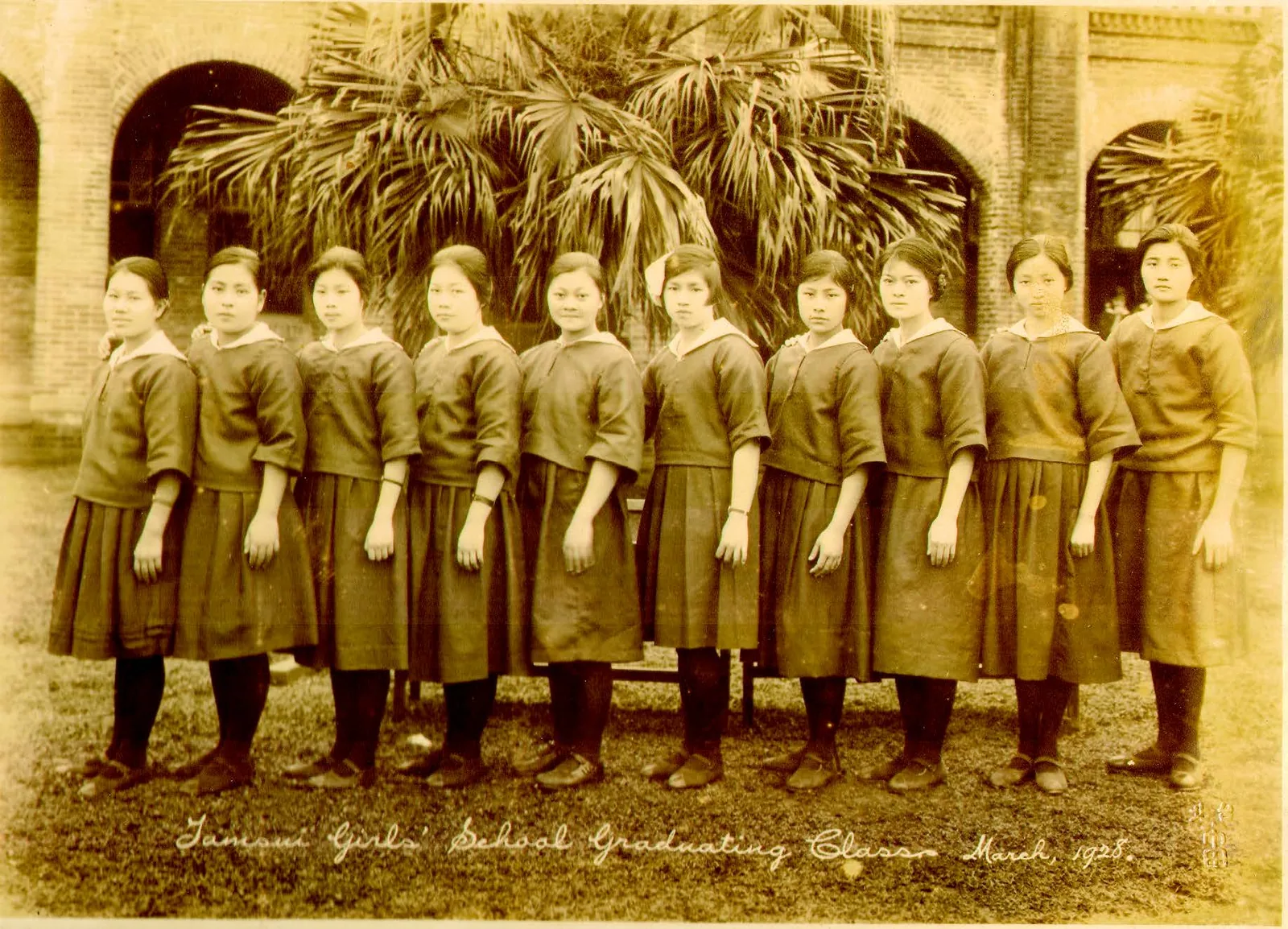
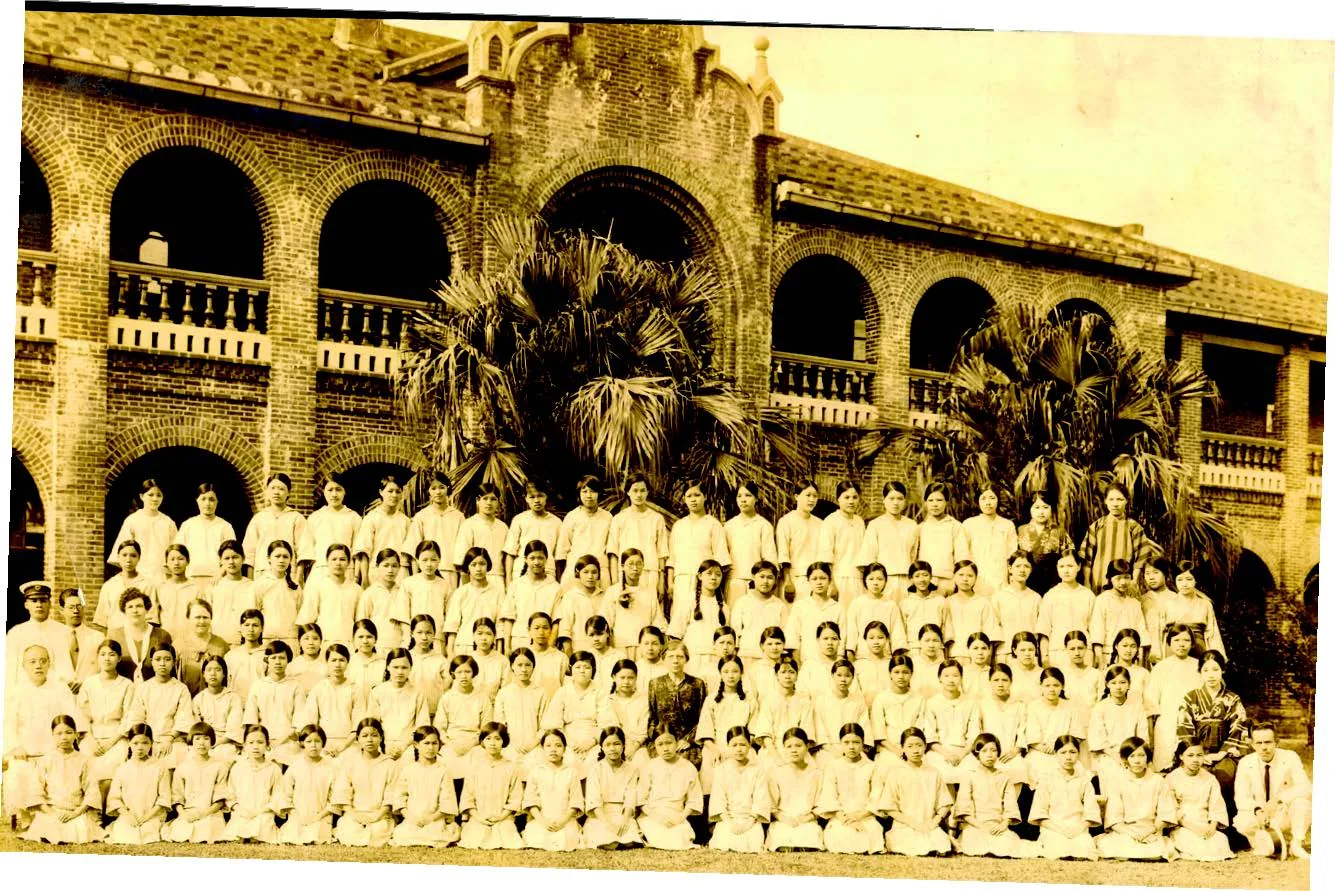
Tamsui Middle School and Tamsui Girls' Academy were a happy place of learning, where academic study and education for living were one, unlike the authoritarian strictness of the Japanese schools. The picture shows the graduates of Tamsui Girls' Academy in 1928
Students of the Girls' Academy with Principal Li Ma-mei (黎瑪美) in 1930.

From the school's opening until 1935 the post of principal was held throughout by Mr. George William Mackay, apart from short periods when he was out of the country and the missionaries Kenneth Dowie (羅虔益), Rev. G. A. Williams (廉叡理), Rev. W. G. Coates (高華德), Rev. James I. Dickson (孫雅各) and Rev. Hugh MacMillan (明有德) acted in his place; his contribution to the early development of Tamsui Middle School was the greatest of all.

Miss Chin Jen-li (金仁理), who held a master's degree in education, was principal of the girls' school for thirteen years and laid a good foundation for it. Unfortunately, in 1927 the Canadian church was divided by disagreements over the merging and separating of church organisations, and this reached as far as Taiwan overseas; because of the change in organisation, a good many missionaries at the two schools left their posts. The following year Miss Chin Jen-li and Miss Kao Ha-na (高哈拿) of the Women's School left, and Miss Li Ma-mei succeeded as principal of the Girls' Academy for three years. In 1931 Miss Dorothy Douglas (杜道理) succeeded her, and the Women's School was taken over by Miss Alma Burdick (閔瑪利) as principal.
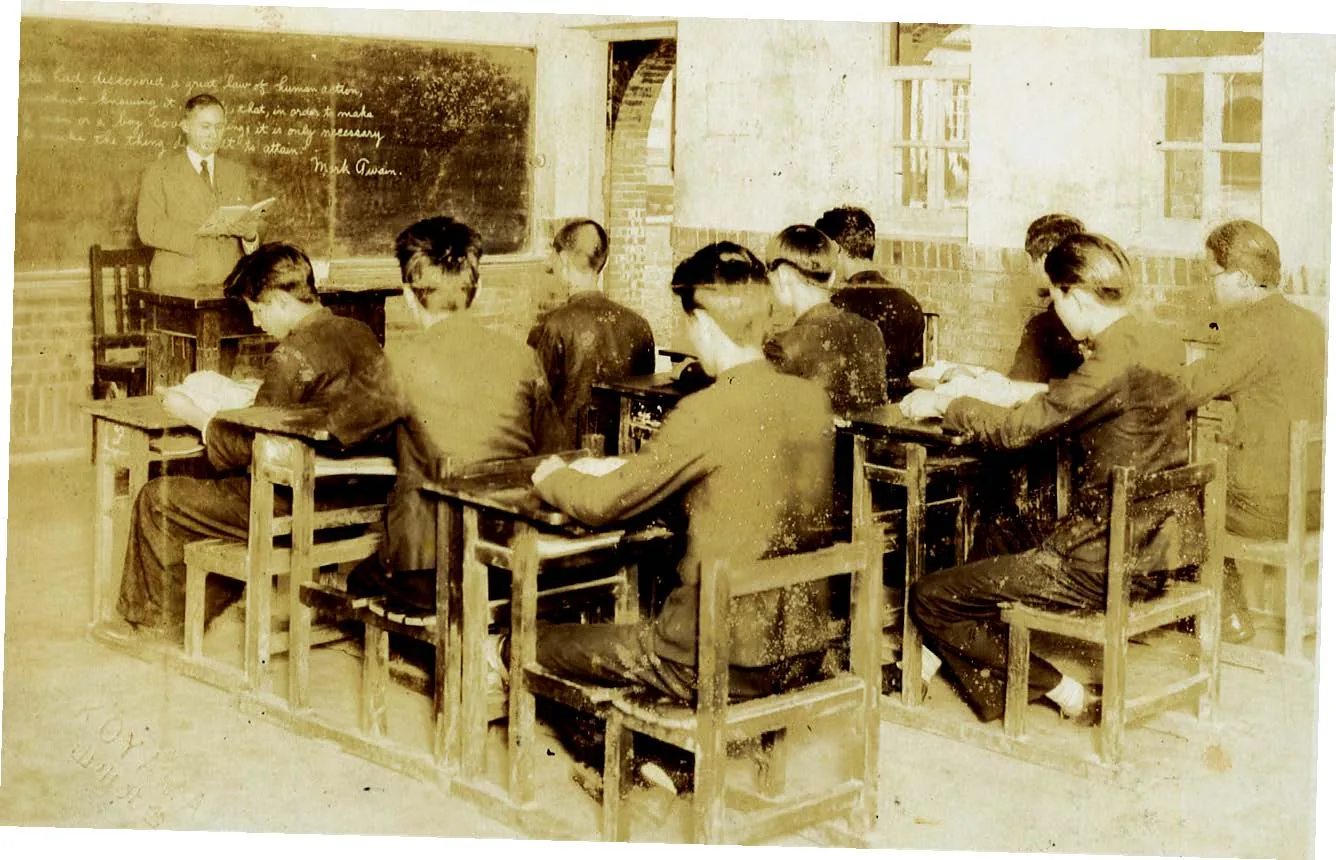
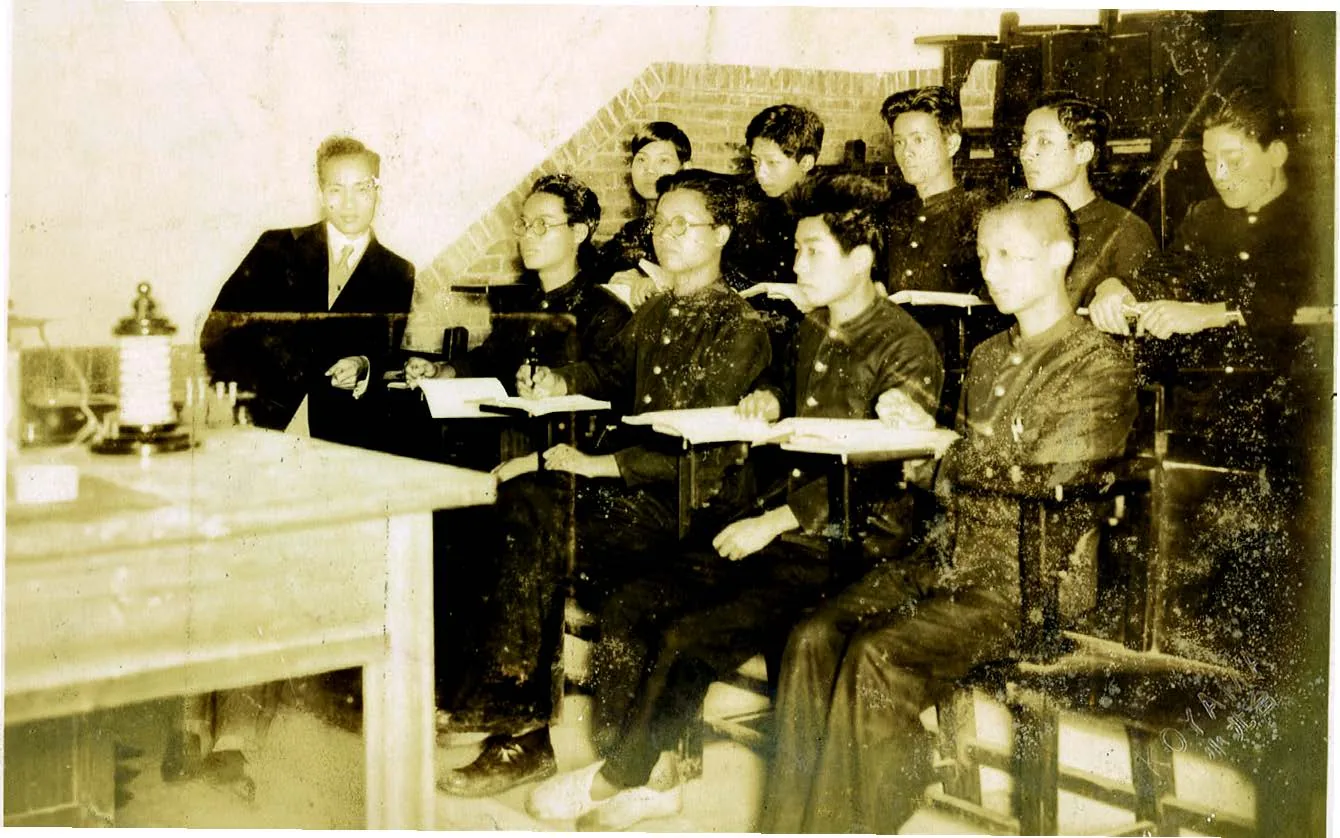
In Japanese eyes Tamsui Middle School was an English school. Above: Principal Mackay teaching English. Below: the physics class of Mr. Chen Neng-tung (陳能通).
Like many teachers at Tamsui Middle School, Mr. Chen was an alumnus of the school.

02The rugby team and the glee club of Tamsui Middle School

After Tamsui Middle School was founded it performed outstandingly in both music and physical education. Besides its traditional learning environment and its free academic atmosphere, the example and encouragement of its teachers also had a definite influence, and of these Mr. Chen Ching-chung (陳清忠) is the most representative.
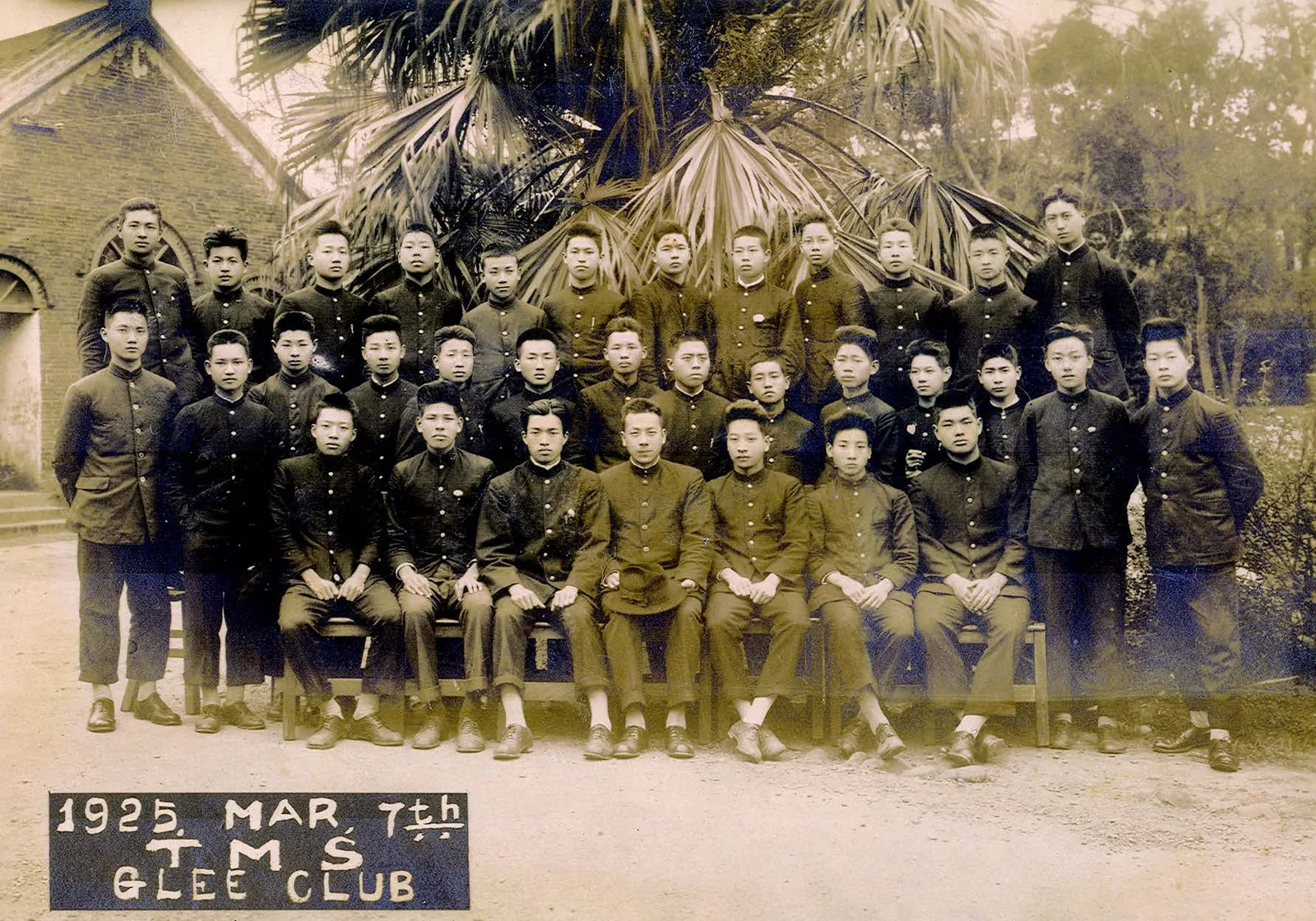
At Tamsui Middle School Mr. Chen Ching-chung formed Taiwan's first male voice choir, the Tamsui Middle School Glee Club (TMS Glee Club).

After graduating from the ordinary course of Oxford College, the forerunner of Tamsui Middle School, Chen Ching-chung went to Japan for further study and graduated from Doshisha University. He returned to his old school to teach in 1921 and fostered a school ethos of both letters and athletics. He was not only a full-time English teacher but also had a talent and a love for music and for sport.

At that time, under the coaching of missionaries such as Mrs. Gauld (吳威廉師母), both the boys' and girls' schools reached a very high standard in music. Under Chen Ching-chung's organisation and training, Taiwan's first choir, the Tamsui Middle School Glee Club (TMS Glee Club), was born. In the summer holiday of 1926 he led the choir on a singing tour of Japan, and its excellent performance won fame abroad. Among the student members, Chen Su-ti (陳泗治) and Lo Hsien-chun (駱先春) both became noted musicians in later years.

In addition, Miss Isabel Taylor (德明利), who graduated from the Royal Conservatory of Music in Canada in 1931, came to Taiwan with Principal Mackay and carried on this work of musical education. She promoted every kind of music teaching in a planned way and also organised and trained the boys' and girls' choirs. Miss Taylor returned to Tamkang after the war and remained in music education until she retired and went home in 1973, making music not only Tamkang's proudest tradition but also making Tamkang the birthplace of modern music in Taiwan.
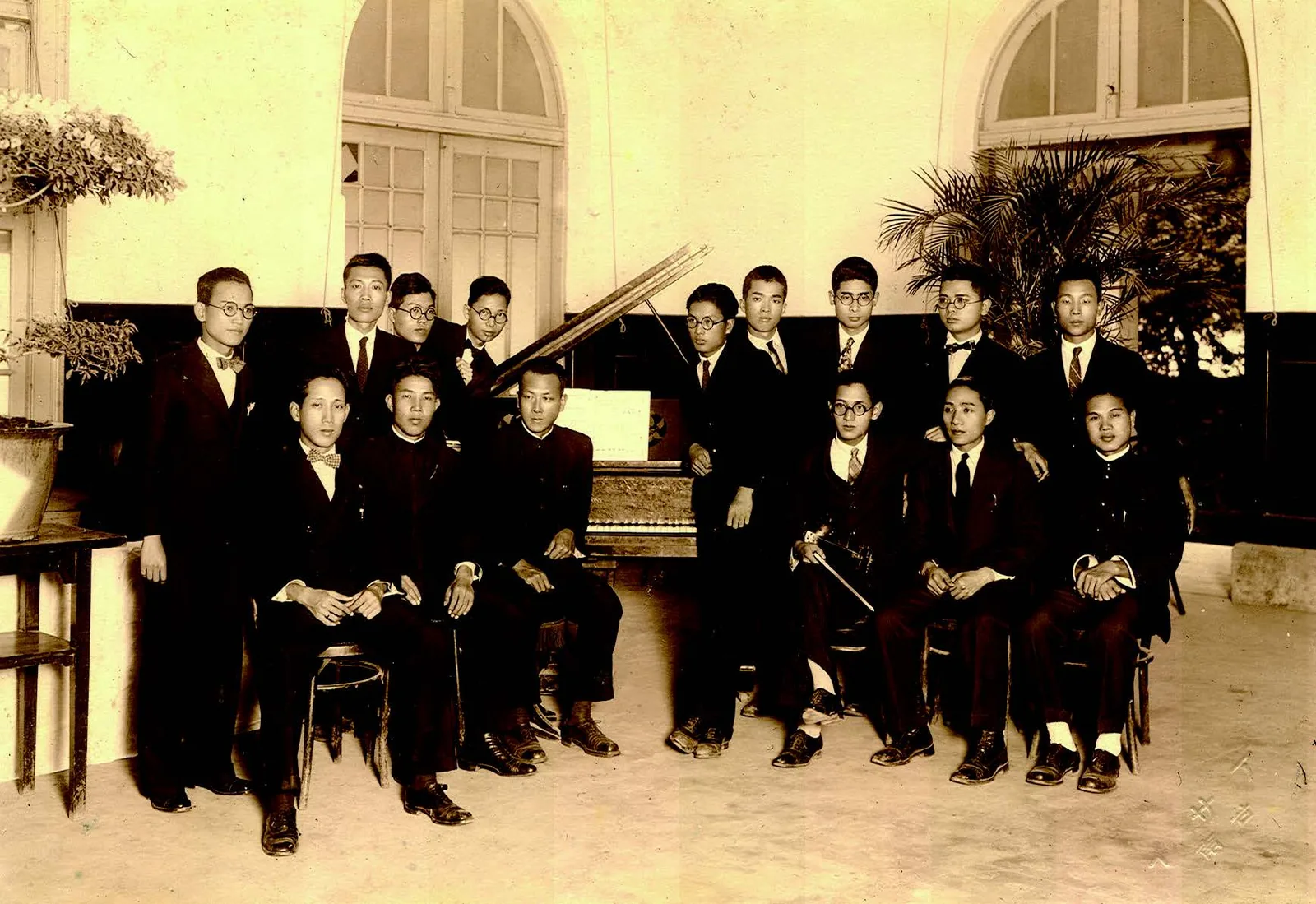
On 27 December 1928 Mr. Chen Ching-chung (front row, third from left) led the male voice choir to sing in Tainan. All the members of the male quartet became musicians and well-known pastors in later years. The better known among them are Lo Hsien-chun (back row, second from left), Chen Su-ti (standing to Chen Ching-chung's right), Chang Kun-yuan (張崑遠, back row, fourth from right), Kuo Ho-lieh (郭和烈, back row, first from right), Cheng Chin-lung (鄭錦龍, back row, fourth from left) and Chan Te-chien (詹德建, back row, third from right).
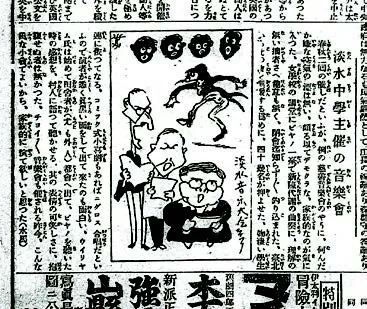
A concert held at Tamsui Middle School drew newspaper coverage.

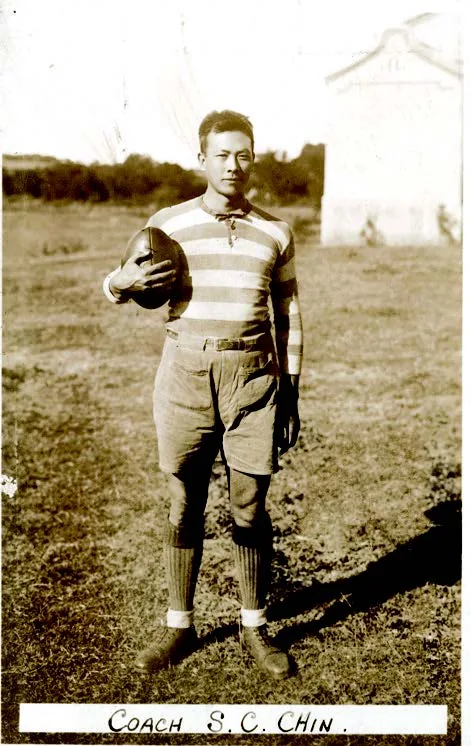
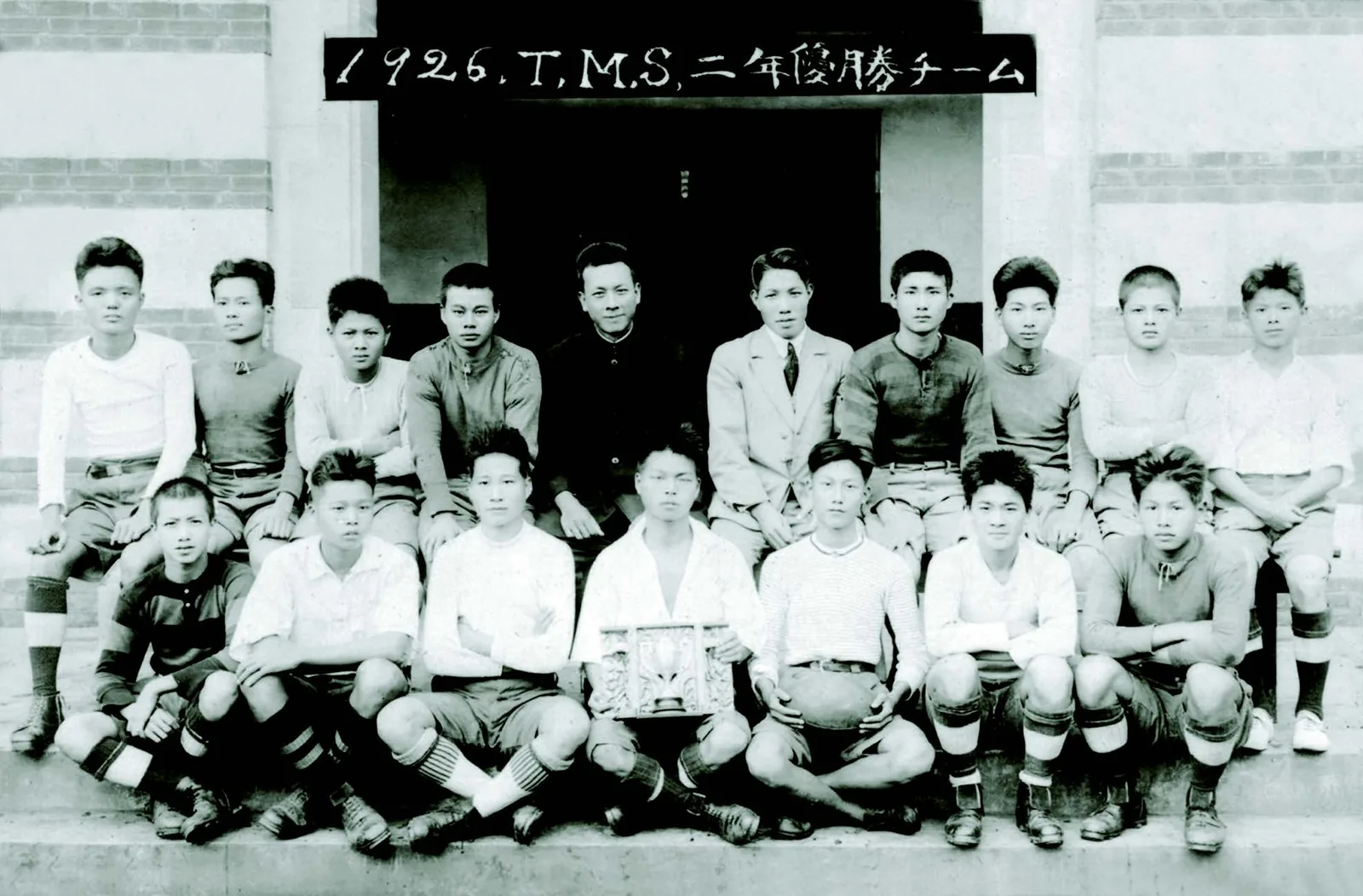
Chen Ching-chung loved sport. He not only led the students up and down the field after class but also let them play with the rugby ball he had brought back from Japan. At that time Tamsui Middle School already had a football team, but apart from a very few Japanese schools rugby was not yet played on Taiwan's campuses. Chen Ching-chung did not merely let the students kick a ball about; he organised and trained them as well. In 1923 the first Taiwanese rugby team was born at Tamsui Middle School.

Because rugby stresses team spirit and is played with great dash, once the Tamsui team had been formed the game also came to be valued by the martially minded Japanese, and the Railway Bureau team, the Taipei Higher School team and the Taipei Higher Commercial School team were founded one after another. Although Tamsui was a middle school while the others were all teams of college-age young men (in the Japanese period the higher schools were preparatory schools for university, and only middle school graduates could sit their entrance examinations), the Tamsui team kept a proud record of never losing to a Japanese team throughout the Japanese period.

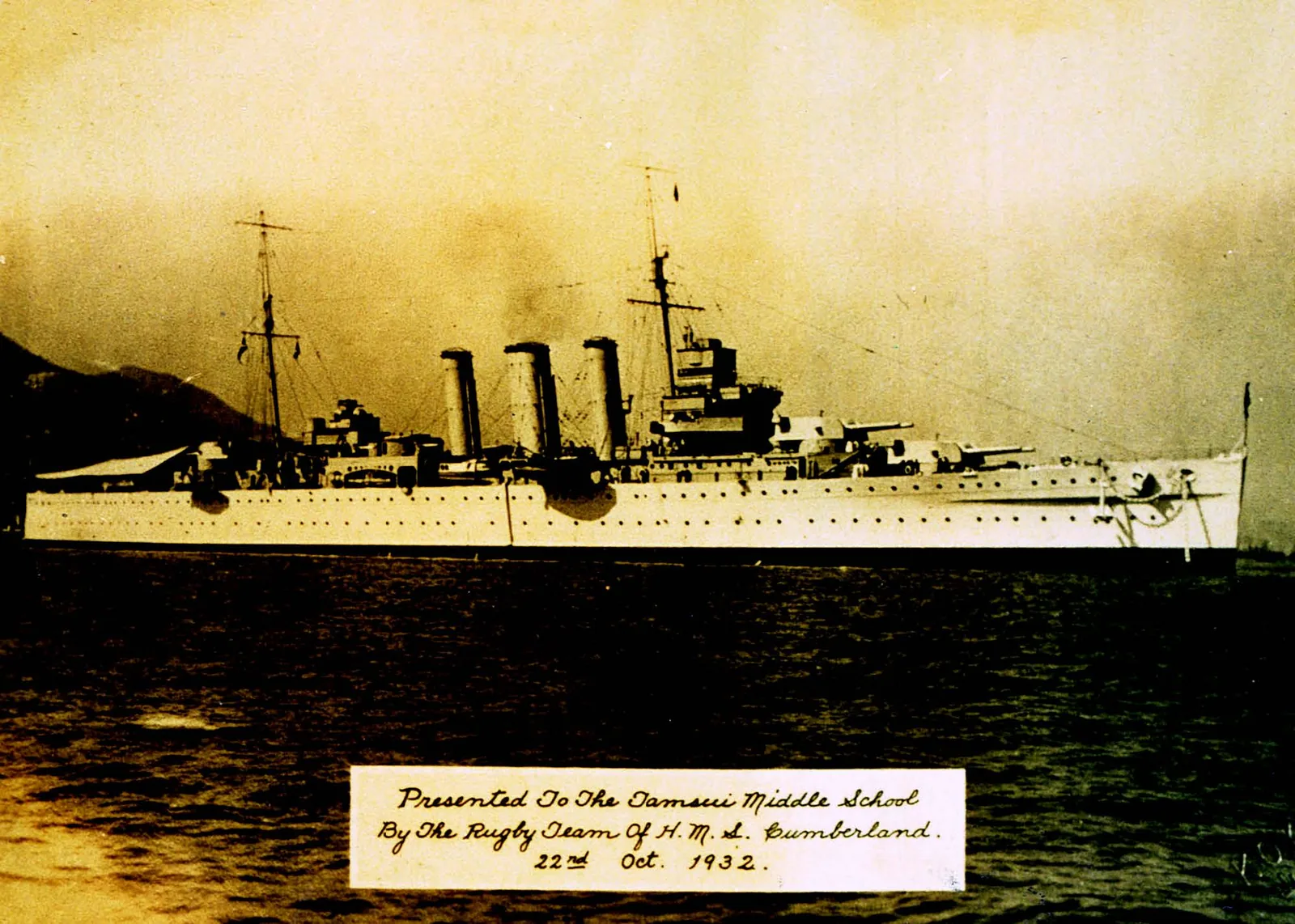
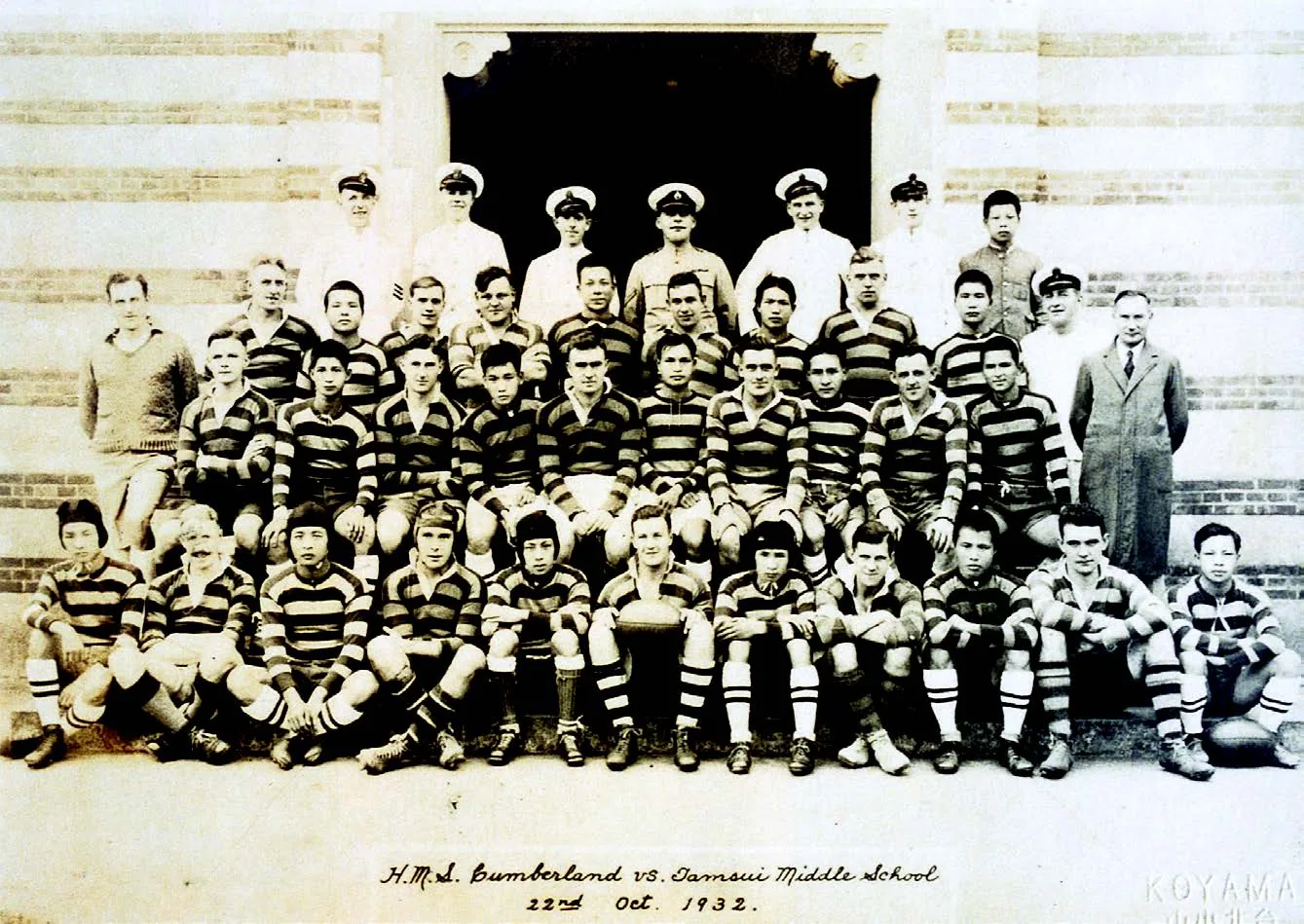
At that time all open sporting competitions were held at the sports ground in Taipei New Park. Taiwanese unwilling to be under Japanese rule would often go to watch these rugby matches, which made the Taiwanese public feel vindicated, and cheer for the Tamsui team. More than that, in October 1932 the Tamsui team defeated the team of the British goodwill warship Cumberland, which had come to Taiwan on a friendly visit, and its name resounded throughout Taiwan.

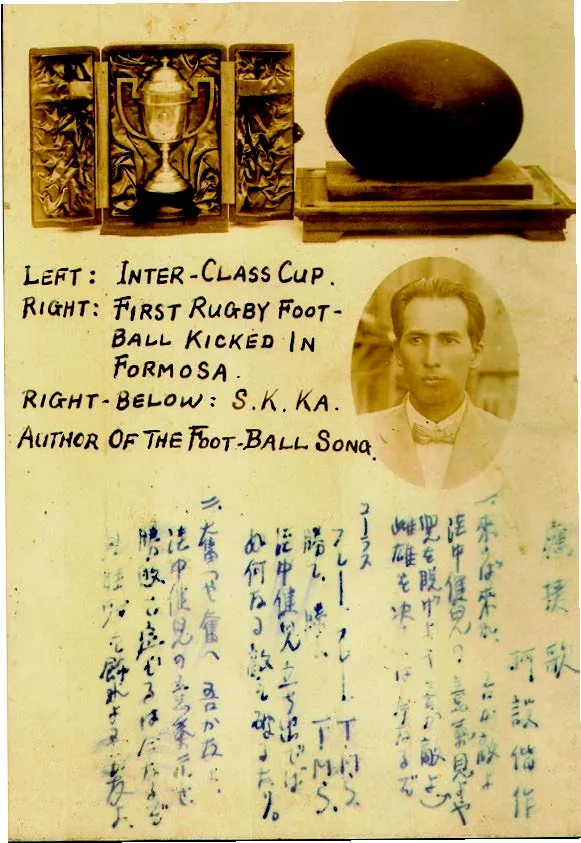
The key to the Tamsui rugby team becoming an invincible force lay with teachers such as Chen Ching-chung and Ko She-kai (柯設偕), who demanded solid basic technique from the players and trained them strictly, together with the team spirit that was a Tamsui tradition. In play, therefore, they were nimble, quick and perfectly co-ordinated, and their opponents found them hard to withstand. Unfortunately, after the Japanese took over Tamsui Middle School the team was suspended for a time and did not reappear until after the war; but rugby had long since become an emblem of the Tamkang spirit.

Besides music and physical education, the influence of religious education was another feature of Tamsui Middle School. Since most of the students boarded and needed more guidance in body and mind, the school not only held ample religious activities but the students also attended worship at Tamsui Church on Sundays. Many teachers and missionaries at the school threw themselves into the work of pastoral counselling, and the most devoted of them was the principal's wife, Mrs. Mackay (偕仁利). She laid particular stress on the teaching of the Bible and organised a summer Bible class every year, which not only gave the students sound development in body and mind but also produced many church leaders; this distinctive tradition is still handed down at Tamkang today.
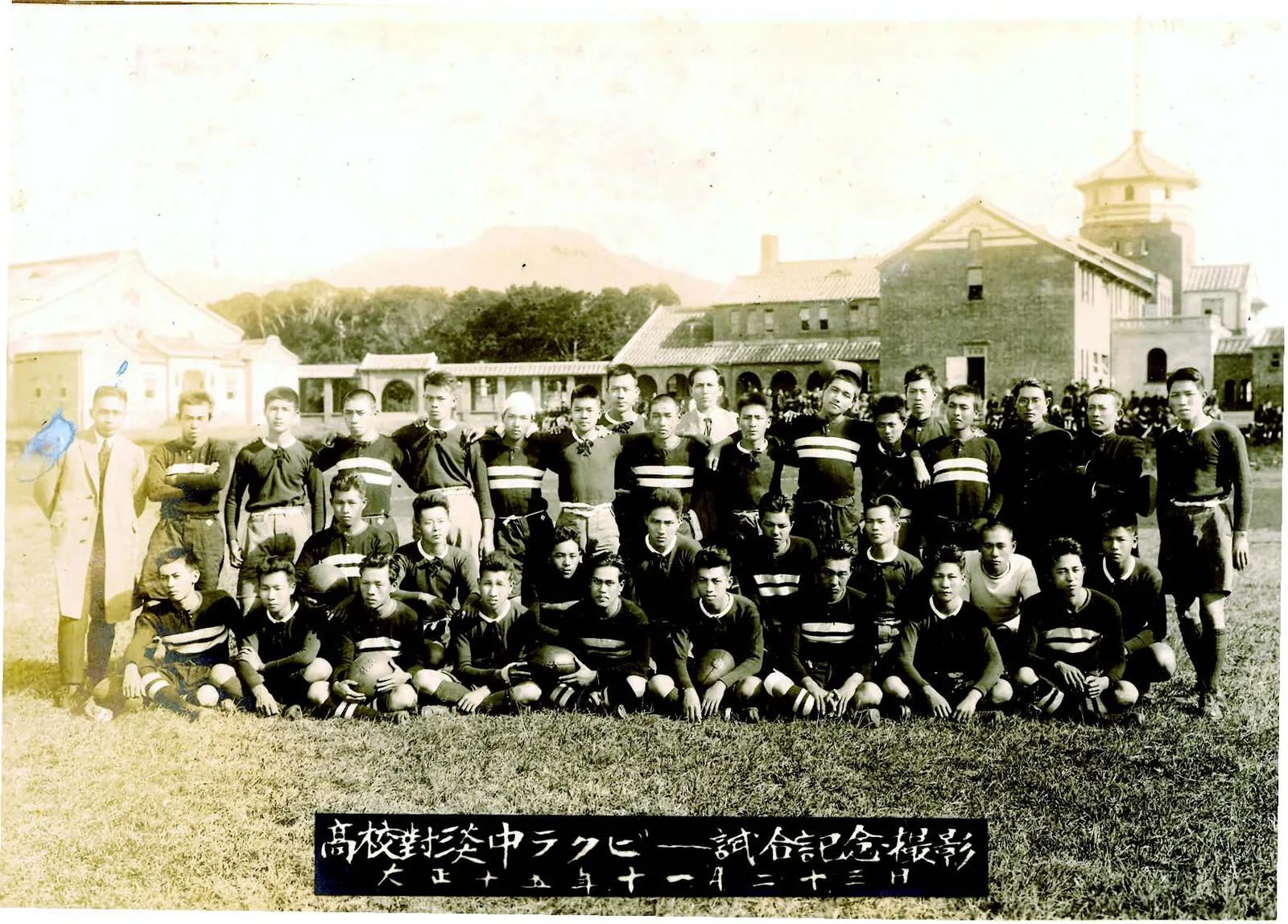
The Tamsui rugby team, formed in 1923, kept a proud record of never losing to a Japanese team throughout the Japanese period. The picture shows Taipei Higher School coming to Tamsui for a match in 1926 and losing to the Tamsui team (0:48).
Students of the Girls' Academy with Principal Li Ma-mei in 1930.
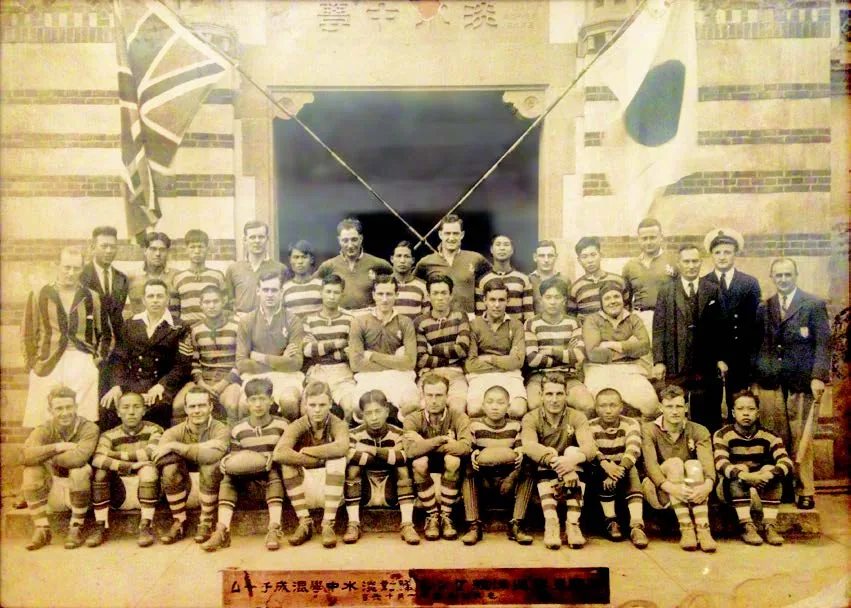
In 1932 the team of the British goodwill warship Cumberland came to Tamsui Middle School for a match. The two teams photographed together in front of the Octagonal Tower before the game; Chen Ching-chung is in the middle of the third row.

03Oppression by the Japanese government and the forced takeover

After the Manchurian Incident broke out on 18 September 1931, the education authorities in Taiwan, wishing to advance the policy of "raising the national spirit", began to take an interest in the spirit of education in the mission schools. The so-called patriotic bodies of the time, such as the Kōseikai (皇政會), even used this to attack the "unpatriotic spirit" of the mission schools, being eager to lay hands on them. In 1933 the question of worship at Shinto shrines gave rise to the Tainan Presbyterian Middle School Incident, and Imagawa (今川淵), then governor of Tainan Prefecture, sought to use the occasion to take over the boys' and girls' schools in Tainan by force; fortunately the southern churches, with the help of the Japanese Christian Church in Taipei, reorganised the board of trustees and appointed a new Japanese principal, and the affair was settled. Tamsui Middle School, however, was not so fortunate.
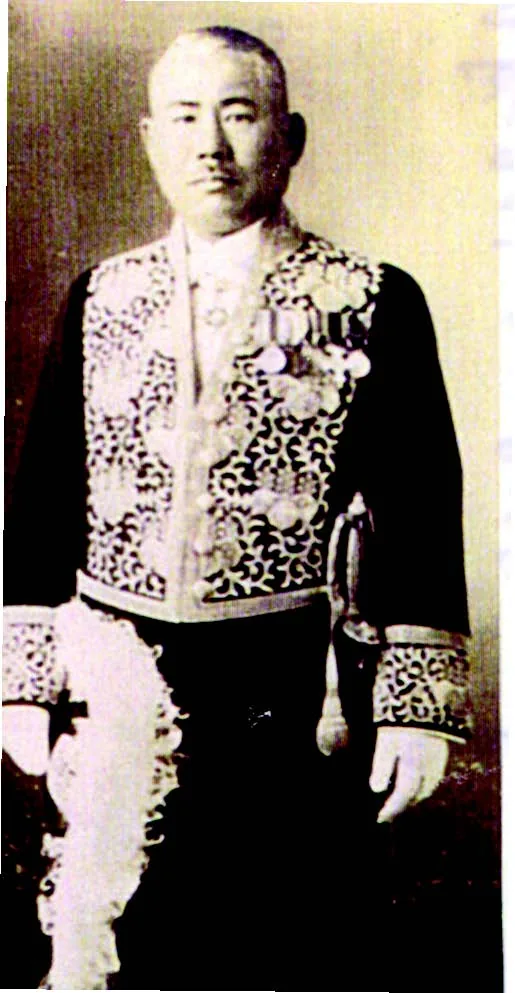
Governor Imagawa (今川淵), the key figure in the seizure of Tamsui Middle School and Tamsui Girls' Academy.

The Kōseikai held a meeting in Taipei attacking the sites of Tamsui Middle School and Tamsui Girls' Academy as land held on "perpetual lease" from the unequal era of the Qing empire: now that it was "the sacred reign of Shōwa", why should an outdated concession still be permitted to remain on Japan's "imperial soil"? The aim of this was to force the church to give up the running of the schools.
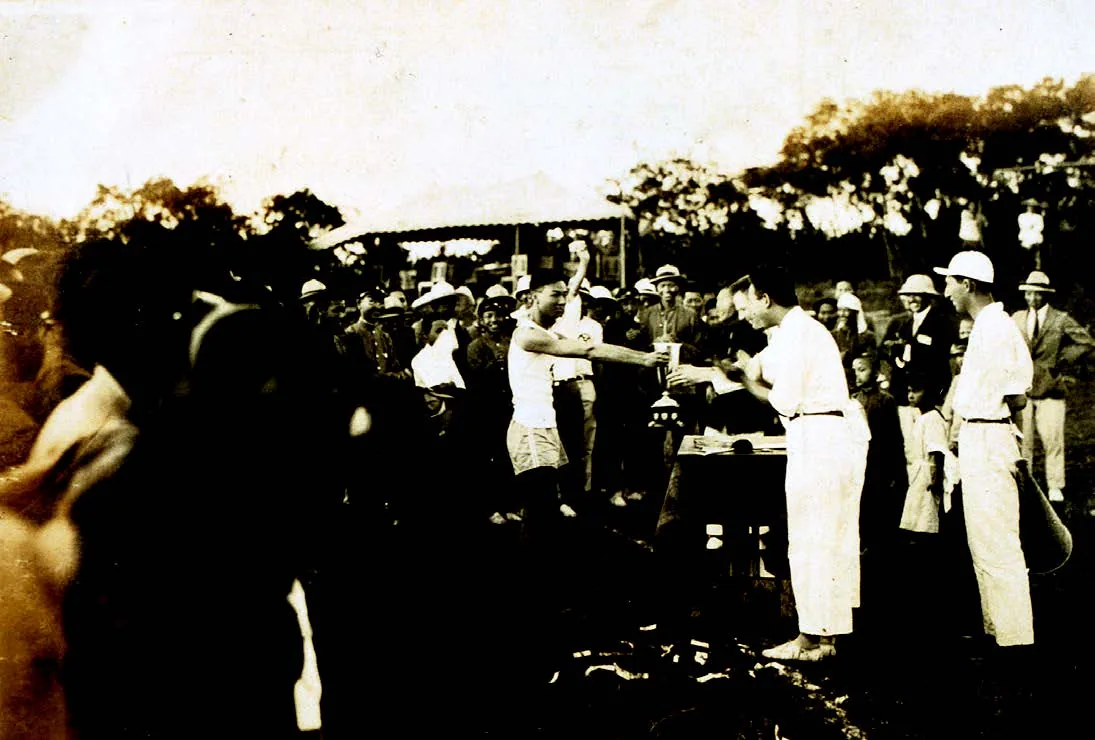
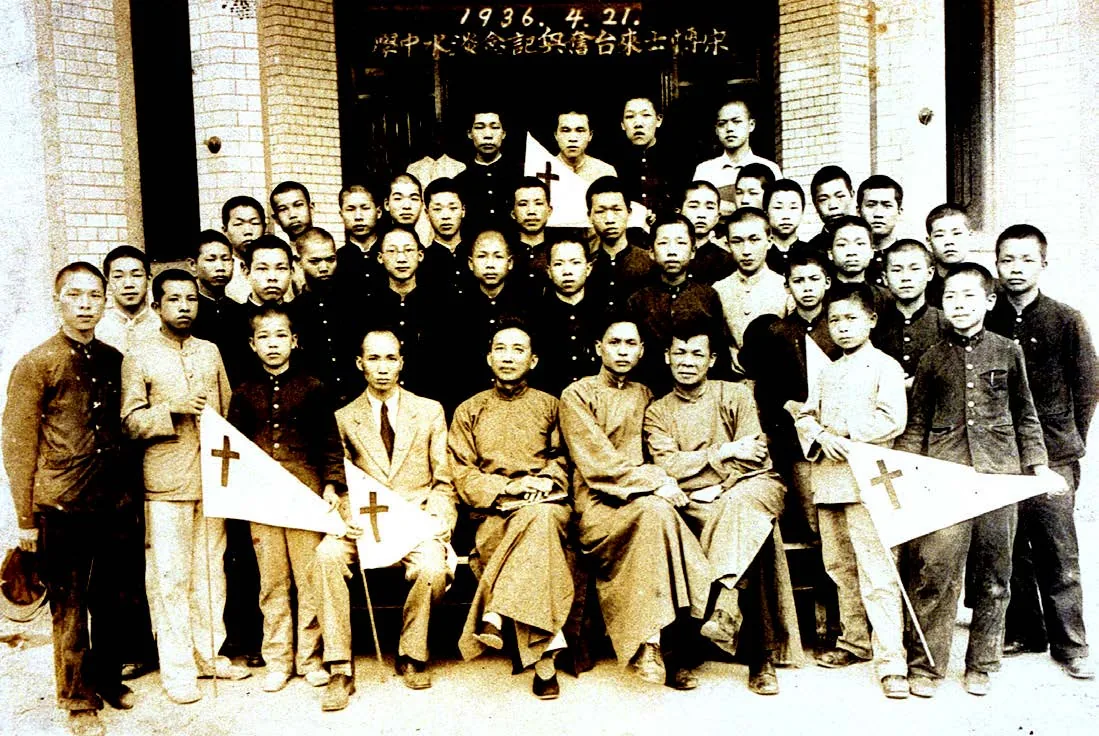
On 27 December 1928 Mr. Chen Ching-chung (front row, third from left) led the male voice choir to sing in Tainan. All the members of the male quartet became musicians and well-known pastors in later years. The better known among them are Lo Hsien-chun (back row, second from left), Chen Su-ti (standing to Chen Ching-chung's right), Chang Kun-yuan (back row, fourth from right), Kuo Ho-lieh (back row, first from right), Cheng Chin-lung (back row, fourth from left) and Chan Te-chien (back row, third from right).
Tamsui Middle School had a free academic atmosphere and close relations between teachers and students, and lacked what the Japanese schools called the "Japanese spirit".
The strong Christian character of the mission schools was also not tolerated by Japanese education policy. Below: students going to Taipei to take part in a revival meeting held by the noted Chinese evangelist Dr. John Sung (宋尚節).
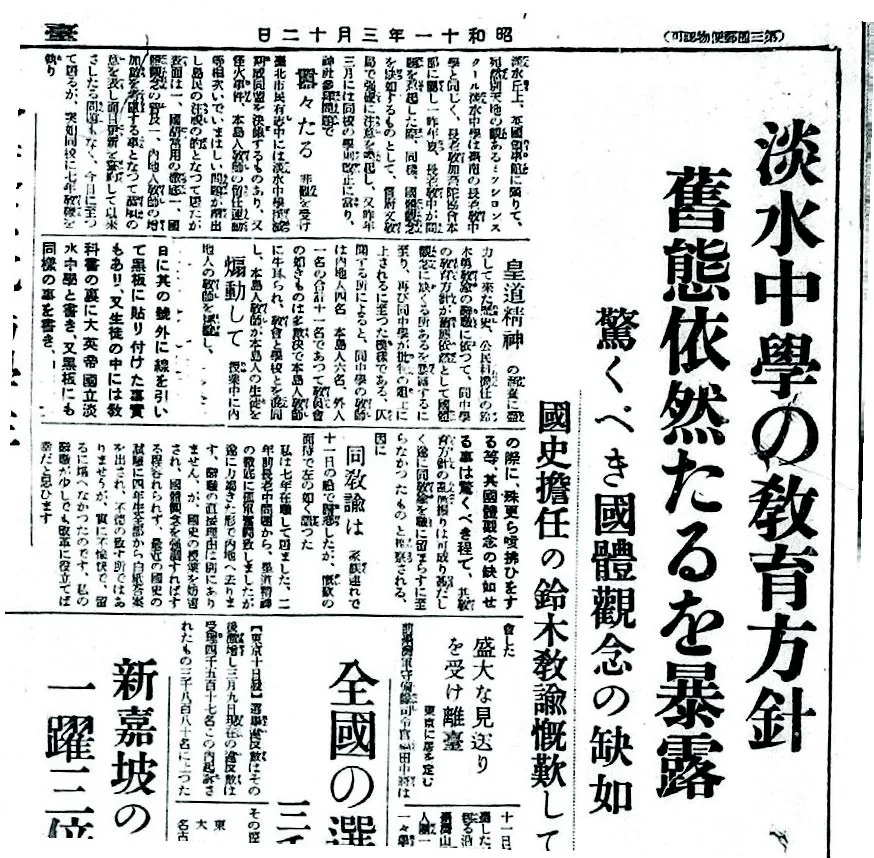
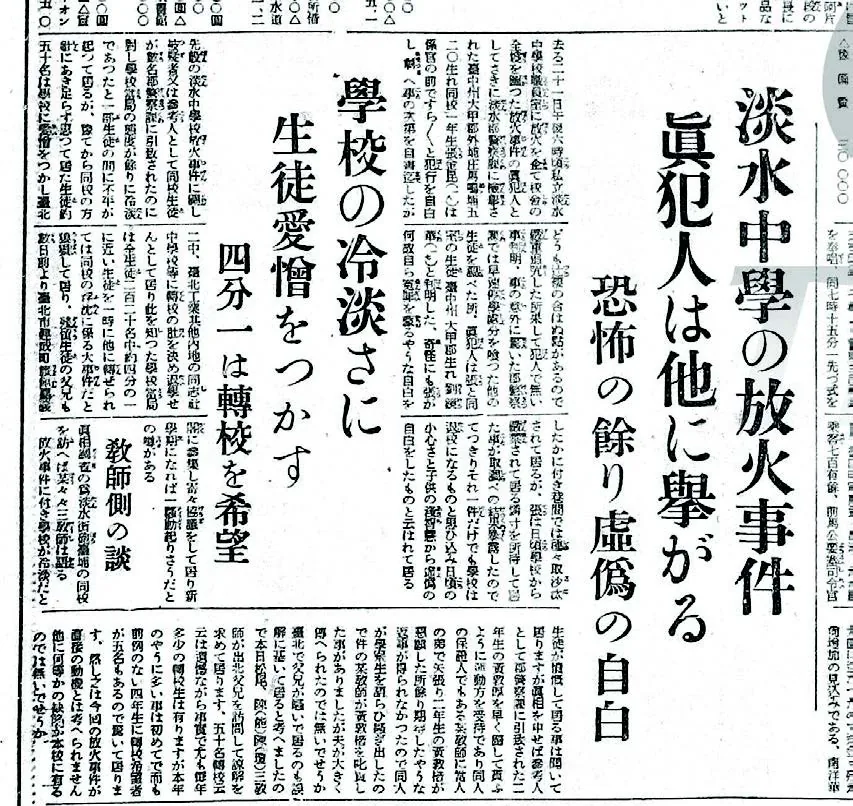
During the "campaign to wipe out Tamsui Middle School" the Japanese repeatedly slandered and attacked the school through the newspapers in order to force the church to give up running it.
Newspapers from the time of the "campaign to wipe out Tamsui Middle School"

In August 1935 the Mission Council that ran Tamsui Middle School, faced with an ever more difficult situation, had no choice but to compromise: besides relieving Principal George William Mackay of his post and appointing Rev. Hugh MacMillan, who was fluent in Japanese, as principal, it engaged a retired Japanese army second lieutenant as instructor and introduced military training courses, in the hope of gaining peace for the two schools.

Unexpectedly, Imagawa, governor of Tainan Prefecture and the key figure behind the Tainan Presbyterian Middle School Incident, was at this point transferred north to become governor of Taipei Prefecture. Just at that moment Suzuki Isamu, a Japanese teacher at Tamsui Middle School, took the occasion of resigning and returning home to tell the press falsely that the two Tamsui schools under the Mission Council's management did not co-operate with the times and promoted an "unpatriotic spirit". This storm rekindled the fight over the survival of the two middle schools and gave the scheming Imagawa his opportunity.

In the name of governor of Taipei Prefecture, Imagawa at once pressed the Mission Council to hand over Tamsui Middle School and Tamsui Girls' Academy to a body organised by himself, at the same time hinting that if the Mission Council did not comply there would be serious consequences.

In August 1936, while the churches in Taipei and Japanese believers were trying to help the Mission Council resolve this unreasonable demand, Tachikawa Yoshio, the head of the education section sent by Imagawa, arrived without warning to take over the two schools and forcibly acted as principal. In fact, under Imagawa's coercion the Mission Council had had no choice but to give way and had transferred the sites of the two schools to the Japanese for 90,000 in banknotes, while all the buildings and equipment of the two schools were also handed over free of charge for their use. The Women's School (婦女義墊, 婦學堂) that stood between the two schools was likewise forced to give up its land. In truth the land of the two schools alone was worth at least 400,000 in banknotes at the time, and Imagawa's conduct was nothing less than plunder.
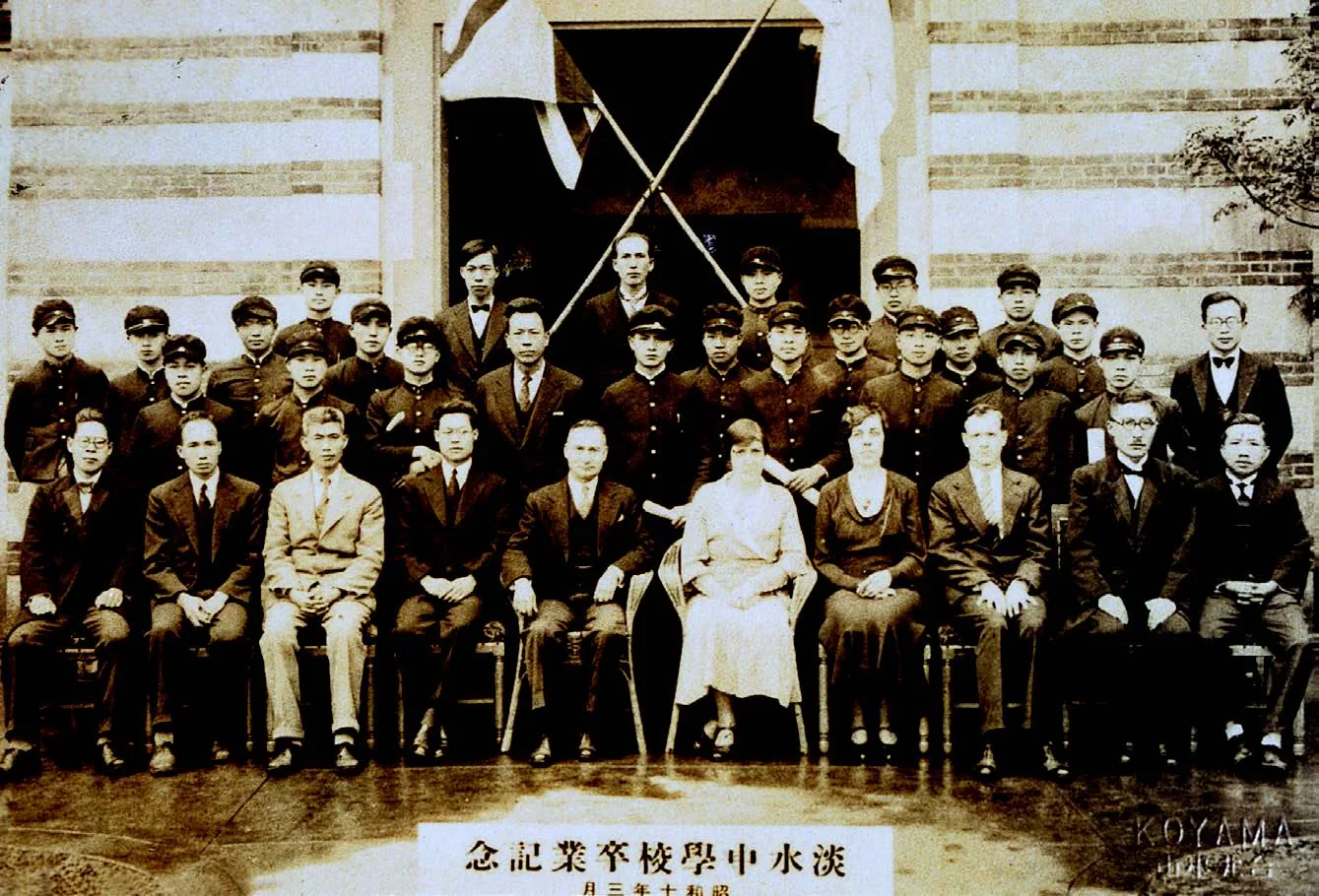
Since the school's founding the post of principal had been held by Mr. George William Mackay. The picture shows Principal Mackay seeing off the last graduating class of his tenure in 1935.
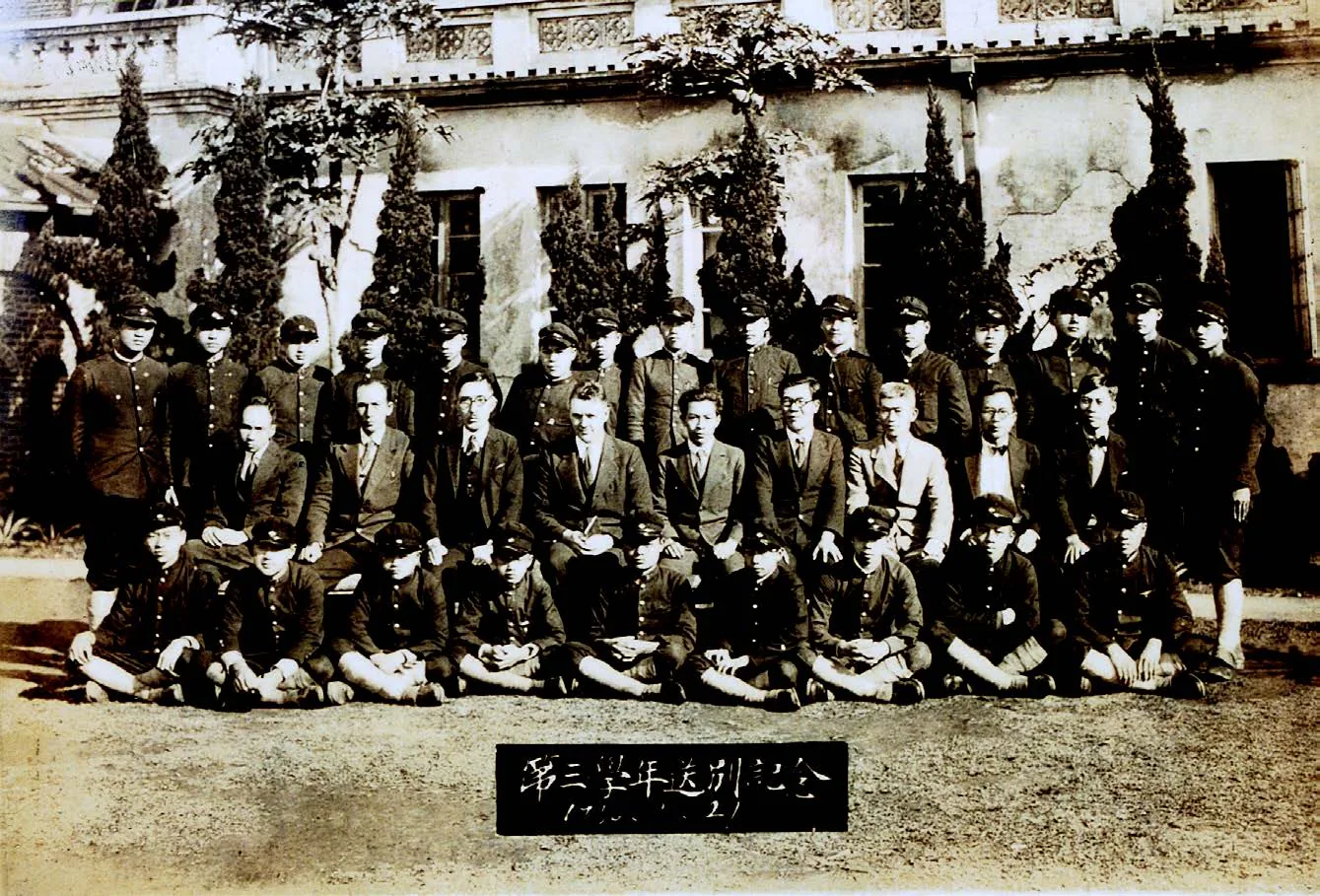
Principal Hugh MacMillan photographed with students leaving the school in 1936. By then the students were taking military training classes (with puttees) and going to worship at the Shinto shrine, but this still failed to satisfy the Japanese government, and in August of that year the school was forcibly taken over by the Japanese.

At that time, beside the two schools, apart from four missionary residences, there stood the Women's School (婦女義塾) and the Taipei Theological College, which held its classes in Oxford College, both still under the management of the Canadian Mission Council. But as the anti-British and anti-American movements grew fierce everywhere, the Mission Council transferred the Taipei Theological College and its property in Tamsui to the Northern Presbytery of the Presbyterian Church in Taiwan. Seeing that war was about to break out and the situation was tense, these missionaries returned home one after another on the orders of the British consul. In September 1940 Japan joined the Axis and became an open enemy of Britain and the United States. At the end of the year the former principal, Mr. and Mrs. Mackay, also returned to Canada, becoming the last missionaries to leave Taiwan.

With this, Tamsui Middle School's missionary era came to an end and the years of Japanese management of the school began.
Governor Imagawa (今川淵), the key figure in the seizure of Tamsui Middle School and Tamsui Girls' Academy.

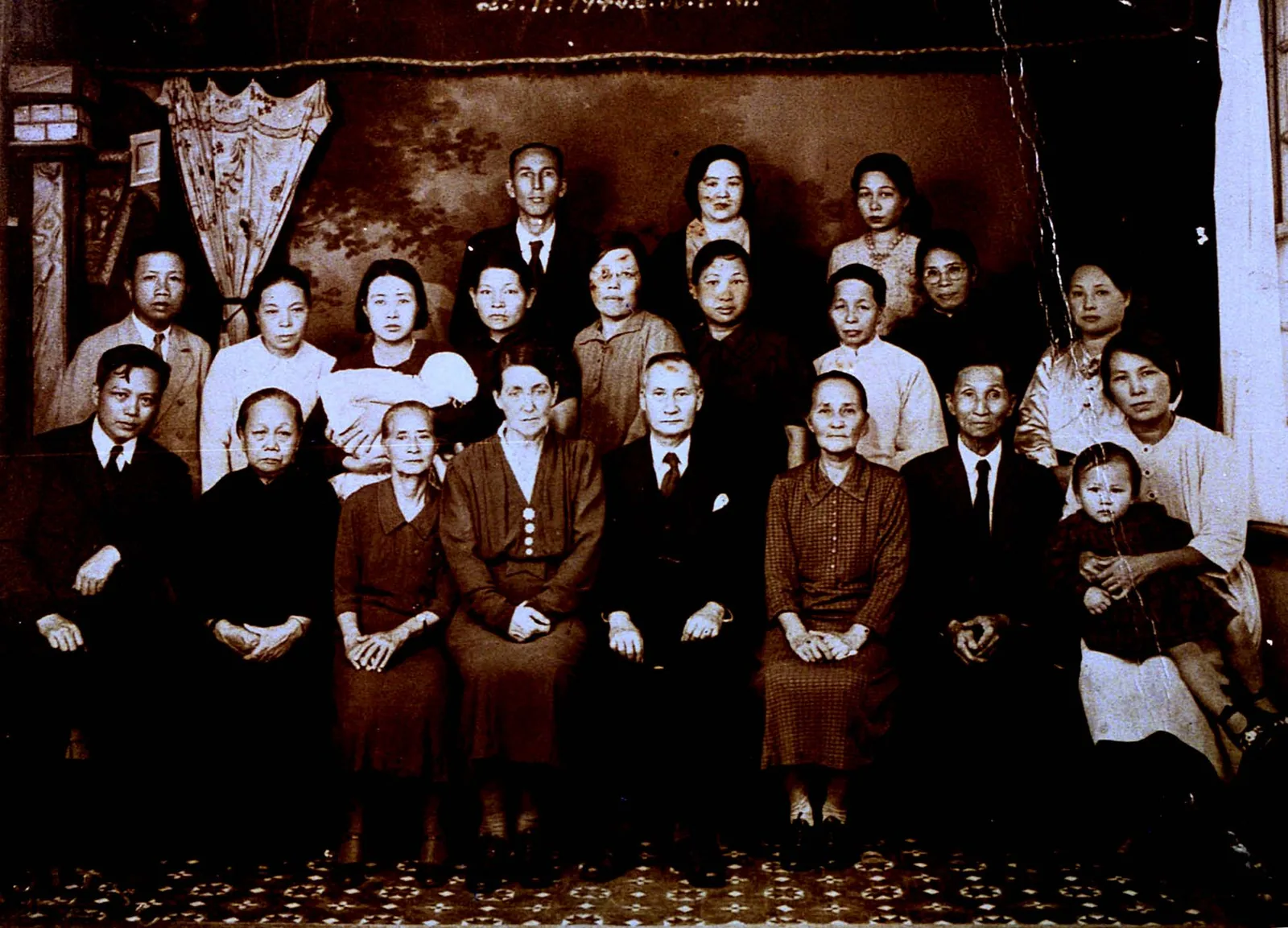
The Mackay family and close friends seeing off Mr. and Mrs. George William Mackay (20 November 1940); he was the last missionary to leave Taiwan.

04Principal Chen Ching-chung, accomplished in both letters and athletics

Mr. Chen Ching-chung was born on 14 May 1895, the second son of Rev. Chen Jung-hui (陳榮輝), a disciple of Dr. Mackay. After graduating from the five-year ordinary course of Oxford College (the forerunner of Tamsui Middle School), he was chosen by the Canadian Mission Council to study at Doshisha University in Japan. While there he was the mainstay of the university's rugby team, leading it in matches without a single defeat and becoming a sporting star known throughout Japan.

In 1921 he returned to teach English at his old school, Tamsui Middle School, and trained and founded Taiwan's first rugby team, for which he is honoured as "the father of Taiwanese rugby". Mr. Chen Ching-chung also devoted himself to music education, organising Taiwan's first male voice choir (the TMS Glee Club) at Tamsui Middle School. On 28 June 1926, during the summer holiday, they sailed from Keelung aboard the Inaba Maru (因幡丸) on a tour of Japan, and he came to be called "the father of choral singing in Taiwan". Less well known is that Mr. Chen Ching-chung was also the first person to translate a play of Shakespeare into Taiwanese and to put it on the stage.
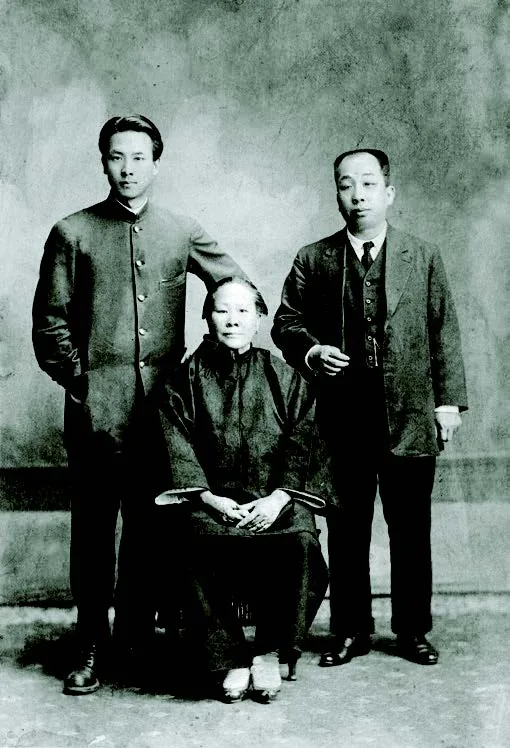
Chen Ching-chung (first from left) in the fine bearing of his youth
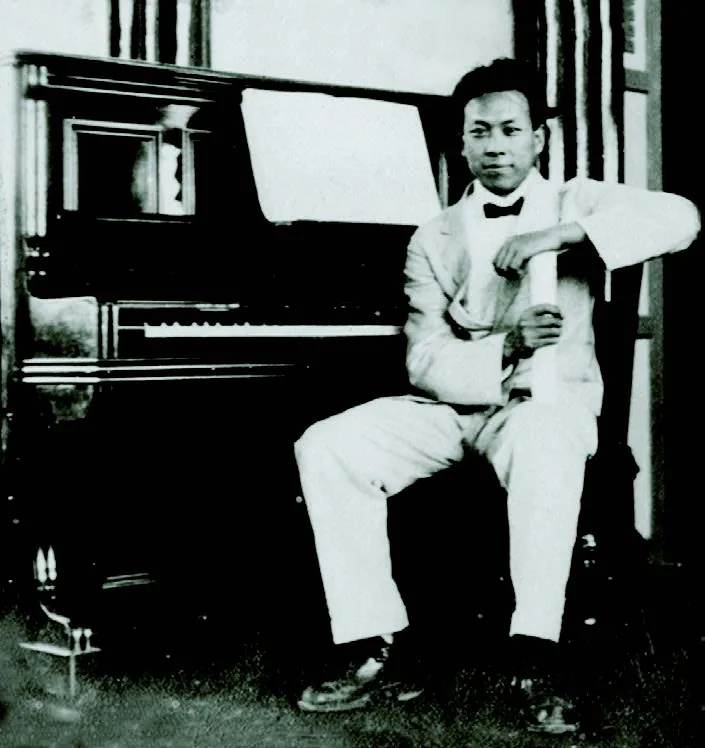
While studying at Doshisha University he served as organist for the university's worship services; the photograph was taken in the Doshisha University chapel.
Principal Hugh MacMillan photographed with students leaving the school in 1936. By then the students were taking military training classes (with puttees) and going to worship at the Shinto shrine, but this still failed to satisfy the Japanese government, and in August of that year the school was forcibly taken over by the Japanese.
Chen Ching-chung in his Doshisha rugby jersey, photographed beside the Tamsui Middle School gymnasium. The jersey is now in the collection of the Tamkang Senior High School History Gallery.

Chen Ching-chung was also very influential in the church's movements of faith. In 1933 he joined with a number of church figures in founding the Union of Elders and Deacons of the Presbyterian Church in Northern Taiwan, of which he was a leading member, and published the Journal of the Northern Preachers' Association, which became a force for reform in the church.

After the war Chen Ching-chung served as principal of Chun-te Girls' Middle School (純德女中) for six years, and in 1947 he founded the Taiwan Rugby Football Association, continuing to promote the game until his death on 6 April 1960.

Chen Ching-chung was not only a distinguished Tamkang alumnus but, through music and sport, fostered a school ethos of both letters and athletics. To commemorate his achievements, Tamkang has held the Ching-chung Cup rugby tournament every year since 1968, and rugby has become Tamkang Senior High School's most important traditional sport; the flowing singing of the male quartet and the choir, too, long ago became part of the school's culture and is still sung today.
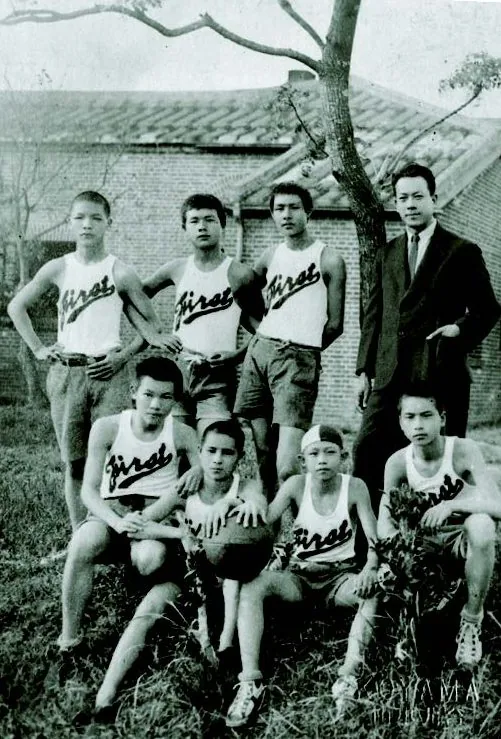
Mr. and Mrs. Chen Ching-chung are remembered for their affection for the students. The photograph shows him with members of the basketball team on the south side of the dormitory. His sporting talents were many-sided: besides rugby and basketball, he was also a noted sprinter at university.

05Racing for the try line — the Tamkang Senior High School rugby team

06The English gentleman's hooligan game
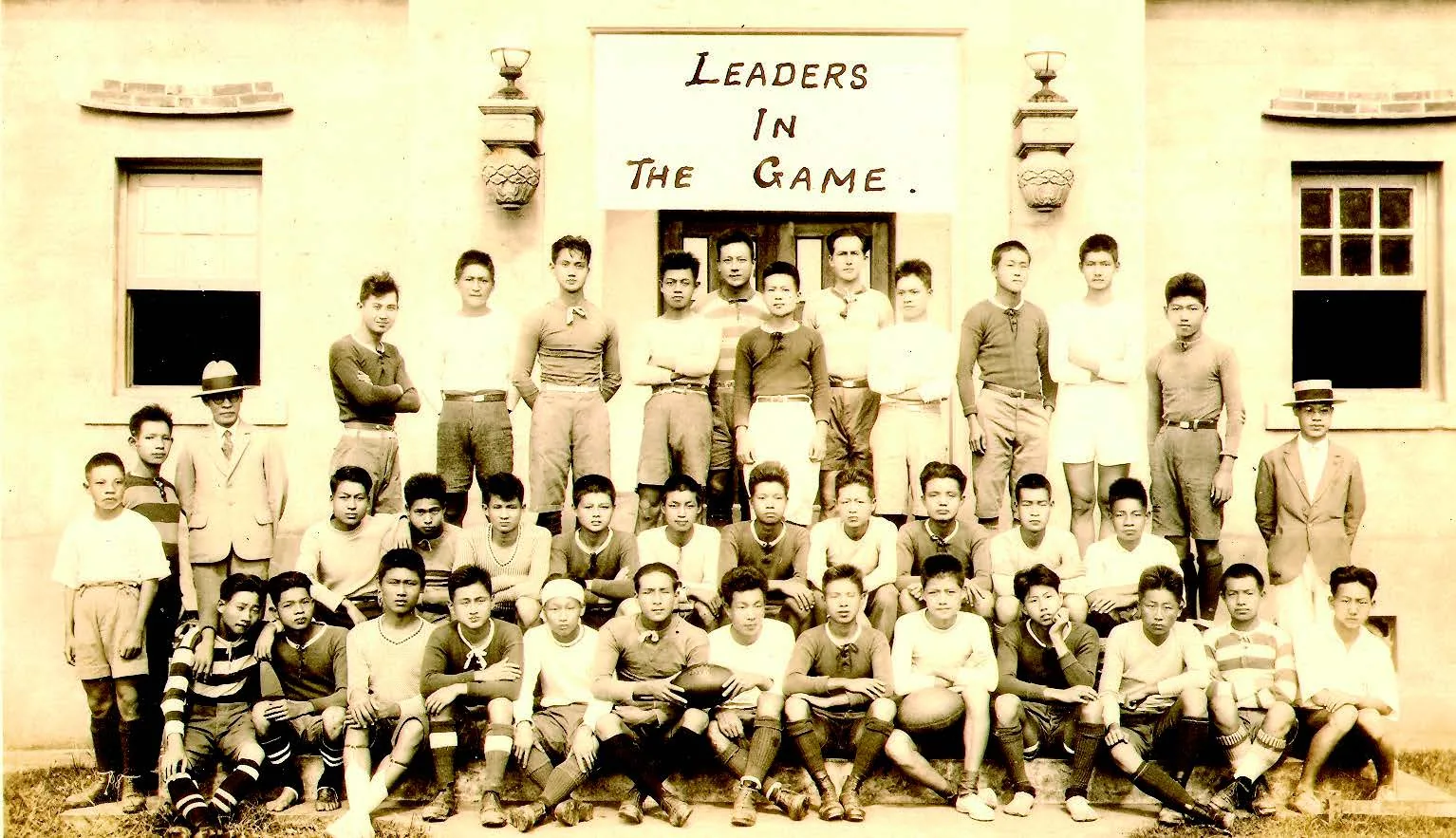
The Tamkang Senior High School rugby team photographed in front of the gymnasium in 1923
The cheering song written for the team by Mr. Ko She-kai

The history of rugby at Tamkang Senior High School is itself a glorious history of Taiwanese sport. The Tamkang Senior High School playing field is a place of great moment in the history of Taiwanese education, and it was here that rugby in Taiwan began and grew strong. Looking back on the development of rugby in Taiwan and recalling Mr. Chen Ching-chung's work in passing on the ball, the Tamkang Senior High School rugby team still runs on the field today, and the rugby spirit of courage, striving, unity and obedience long ago became the traditional spirit that each generation at Tamkang Senior High School pursues.

Tamkang Senior High School was founded just after Japan's Meiji Restoration; in a social atmosphere of wholesale Westernisation under the slogan "leave Asia, enter Europe", the football and rugby of the British upper class became fashionable, and rugby in particular, nicknamed "a hooligan's game played by gentlemen", was admired by Japanese society. Chen Ching-chung was studying in Japan at just this flourishing time.

When Chen Ching-chung returned to teach at his old school he brought rugby onto the campus as well, letting the students learn through play, encouraging the game, and then training them and forming a team; in 1923 Taiwan's first rugby team, the Tamsui Middle School team, was founded.
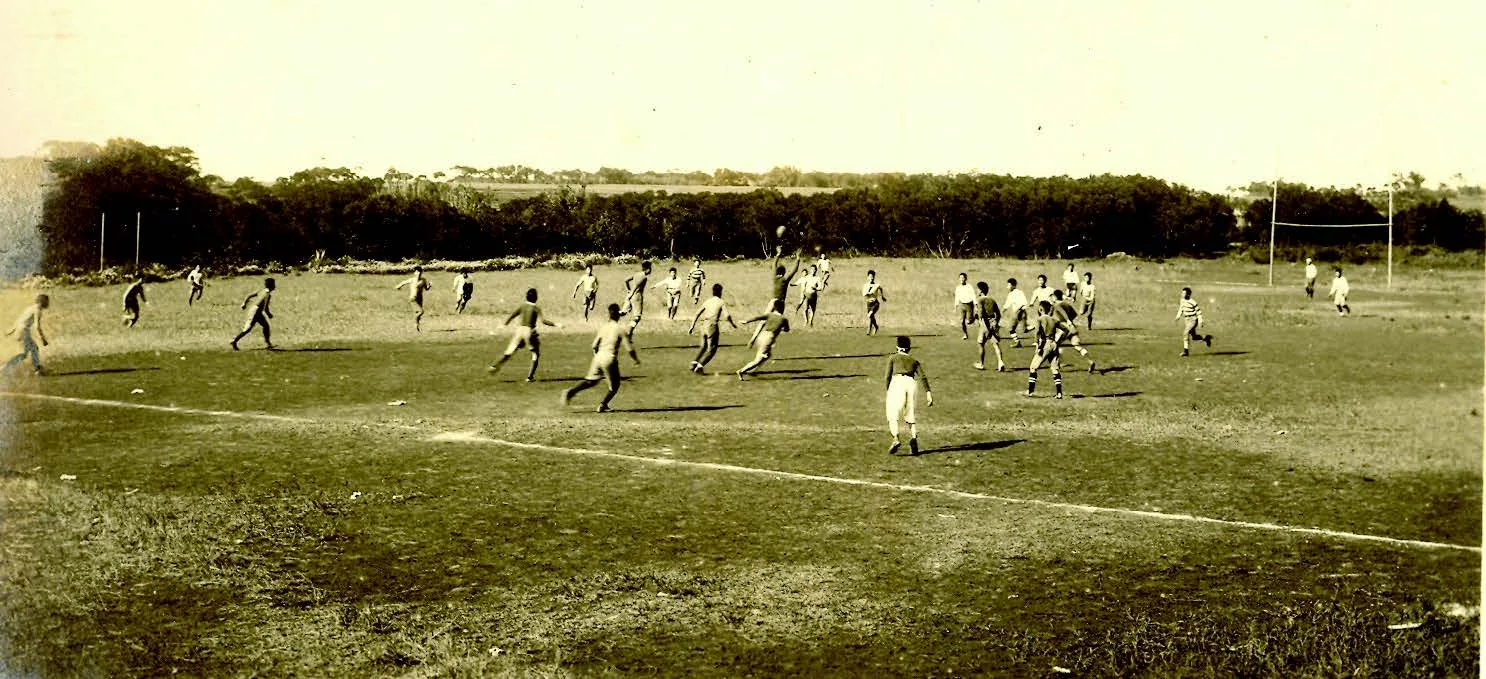
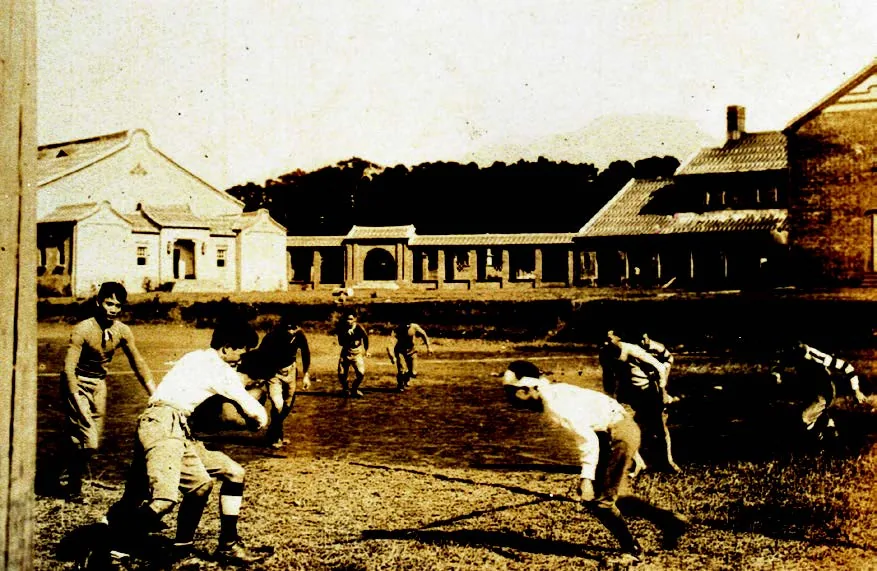
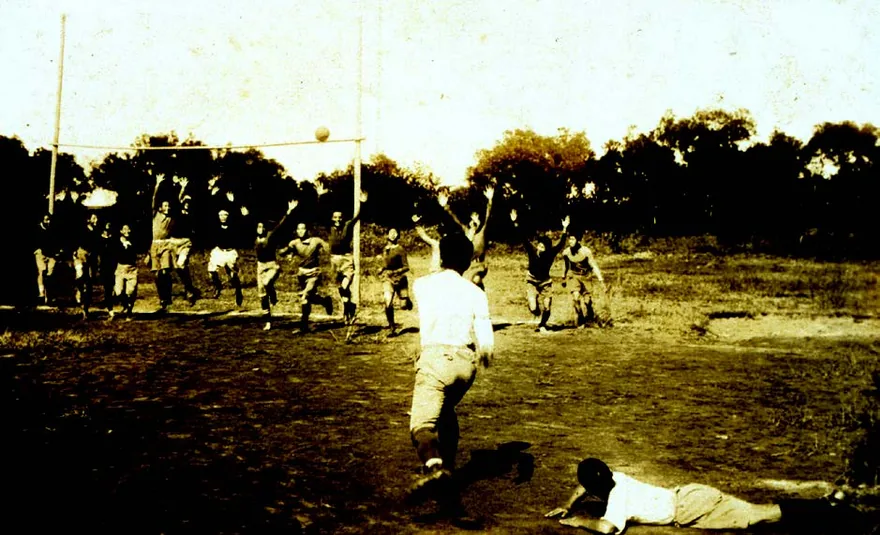
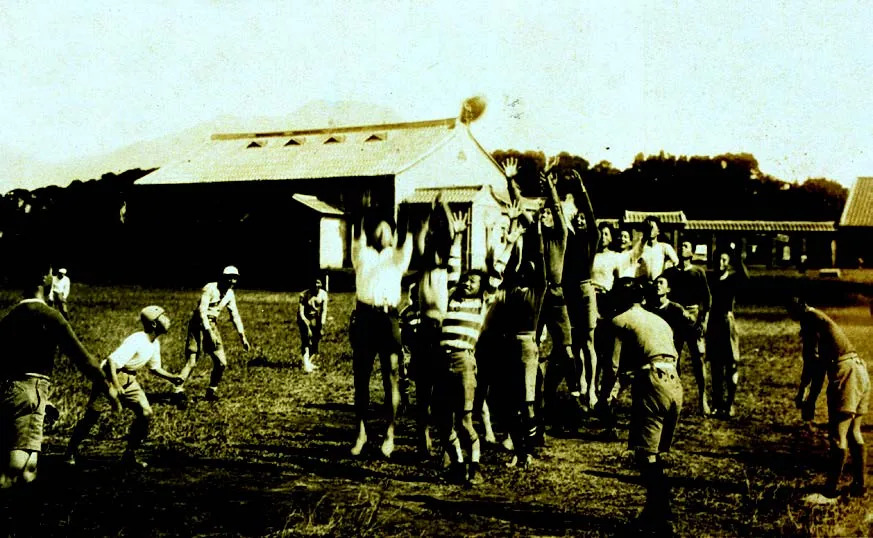
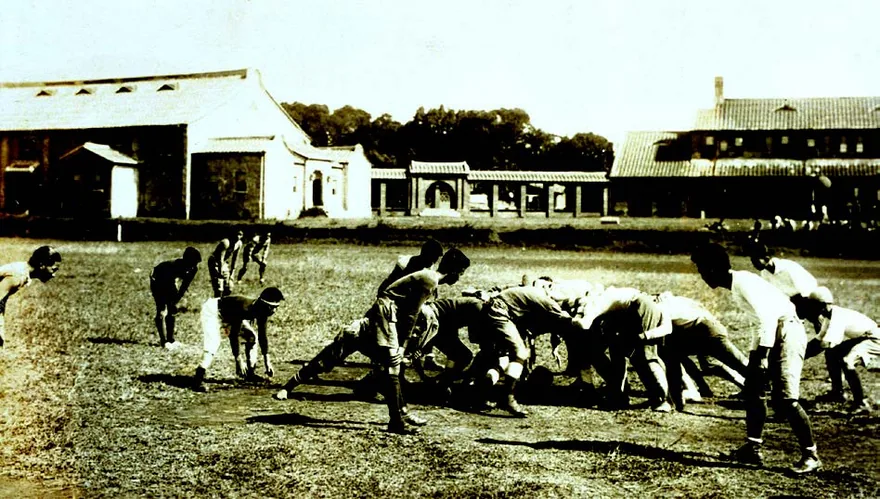
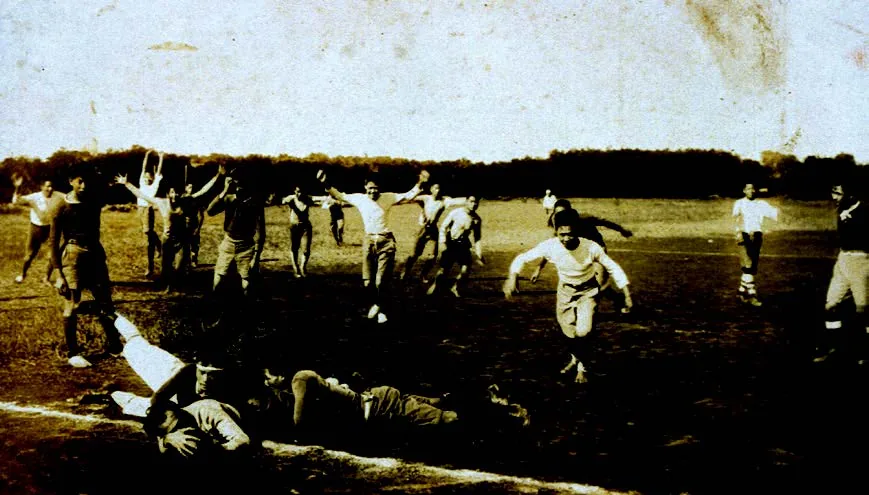
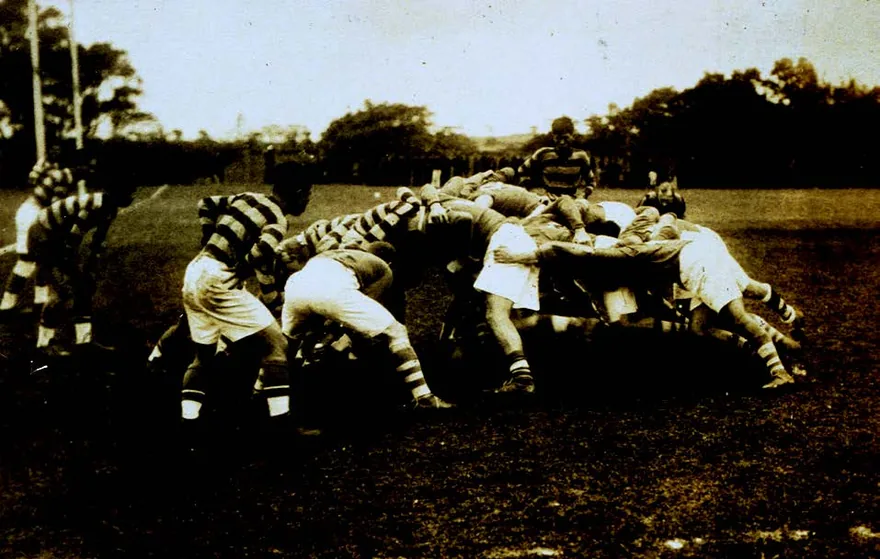
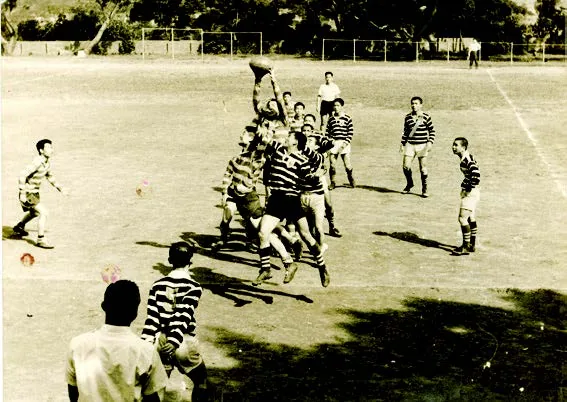
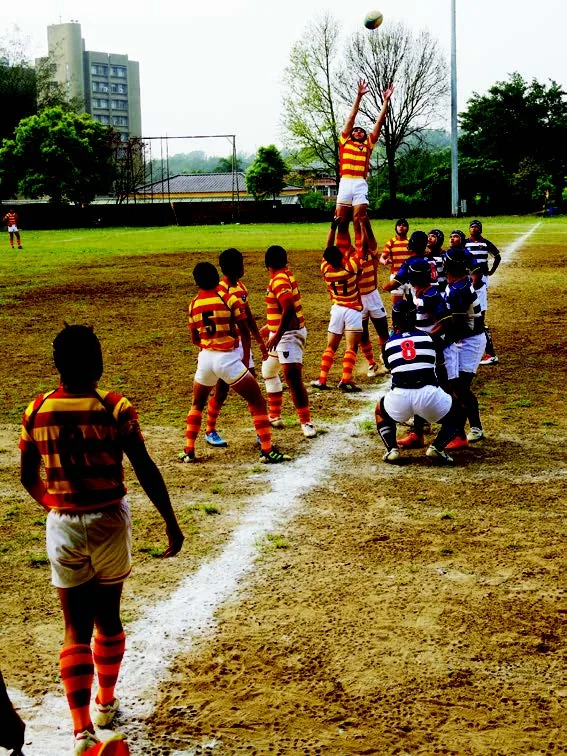
The Tamsui Middle School team was formed at its founding by calling for players among more than a hundred boarders. After class Mr. Chen Ching-chung would blow a whistle to gather them to play with the ball; at first it was an after-school activity rather than something aimed at matches. From playing with the ball, through training, to the formal founding of the team there was no outside team to play against, so the players were divided by position into two evenly matched sides. In the picture one can see the basic skills being learnt: the try (Try), the scrum (Scroum), the goal (goal) and the line-out (Line-out). In particular, the photograph records one of the players, Mr. Ko She-kai (he had been a Doshisha player), breaking through the defence and, though tackled (tackle), still grounding the ball to score, with the players leaping and cheering.

07The years of passing and scoring

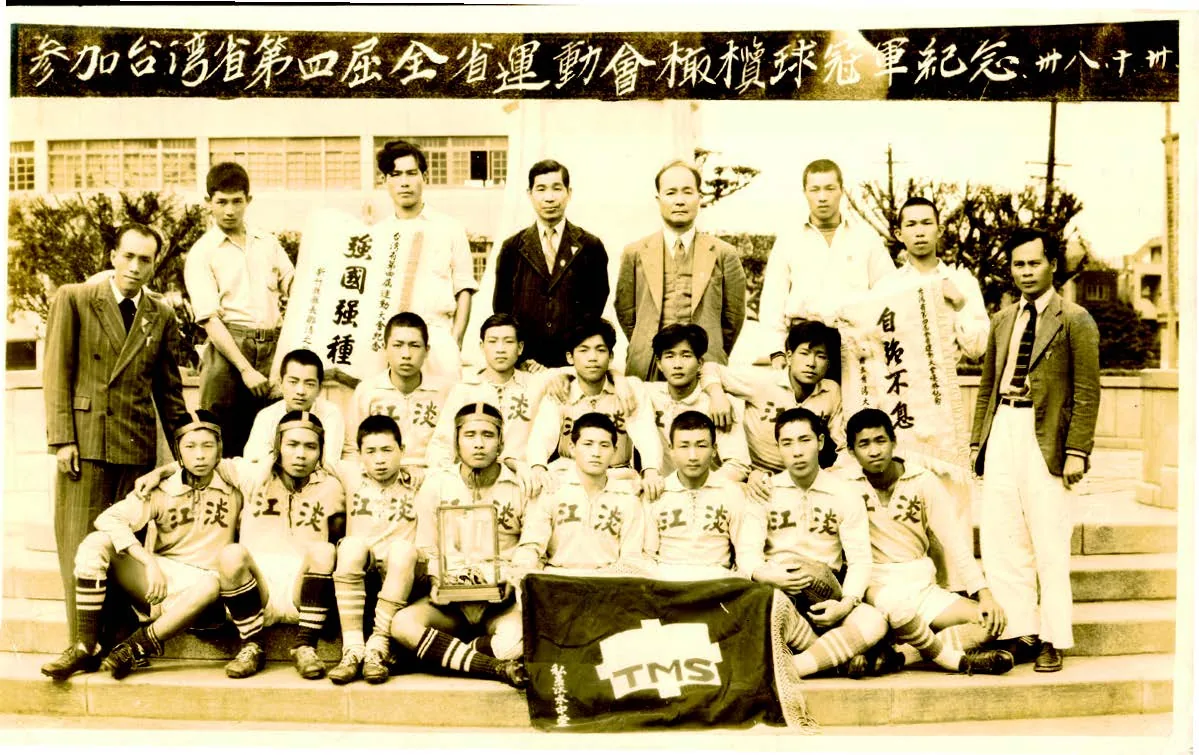
After Tamsui Middle School formed its team, beginning with its first victory over the Japanese "Taipei Combined Team" in Taipei by 3:0 in 1924, it was invincible throughout the Japanese period and kept an unbeaten record against Japanese teams. It not only wrote a glorious record but also won national dignity for Taiwanese under Japanese rule. In 1932 it defeated a strong side that had come to Taiwan to challenge it, the team of the British Far East Fleet's Cumberland, and its fame spread far and wide, at home and abroad. Unfortunately, after Tamsui Middle School was forcibly taken over by the Japanese in 1936 the illustrious Tamsui team had to be discontinued. But in those ten years and more the Tamsui Middle School team laid a firm and glorious foundation for rugby in Taiwan.
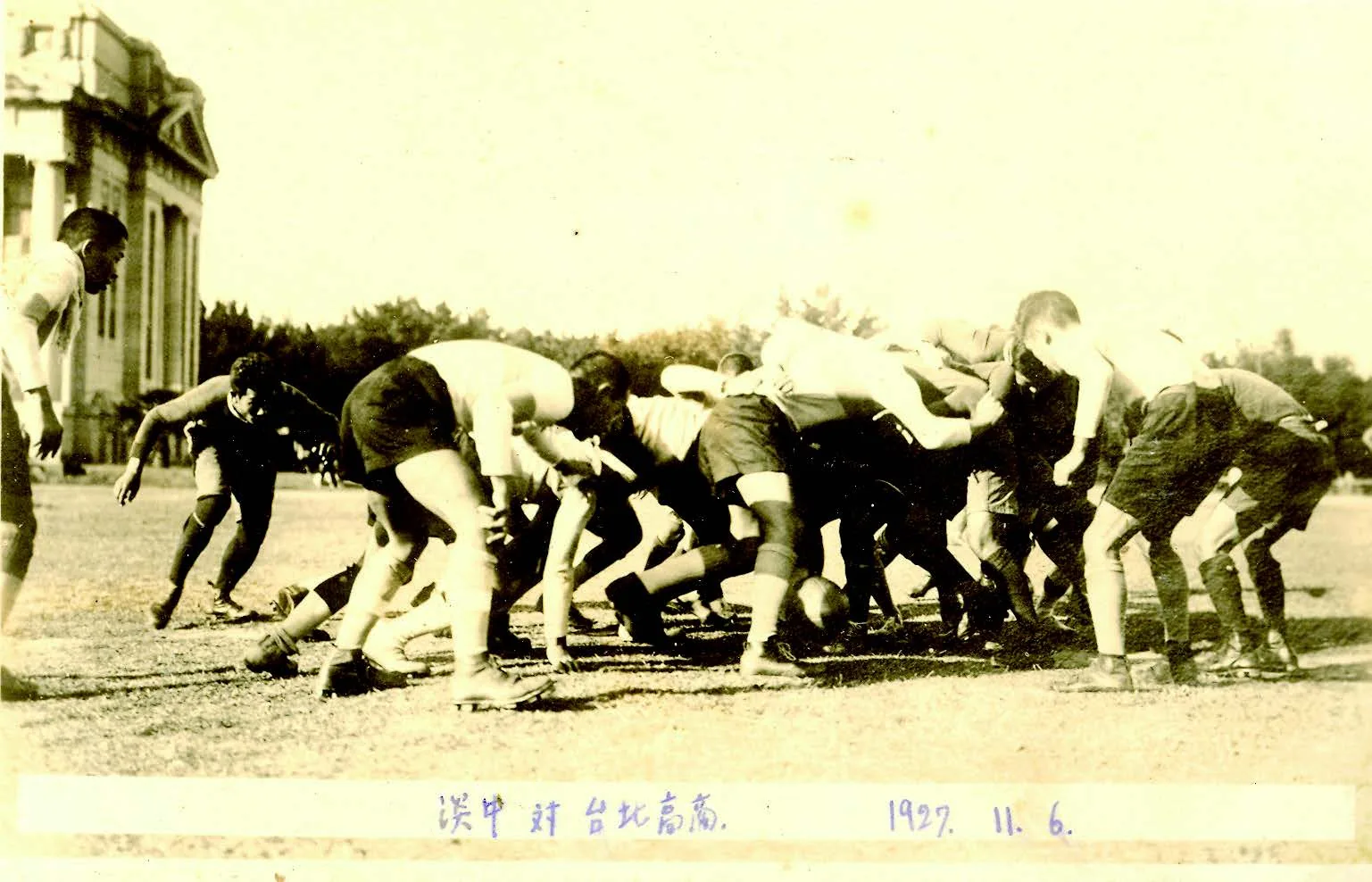
In the Japanese period large sporting competitions were all held at the sports ground beside the museum in New Park, and the Tamsui Middle School team, representing the Taiwanese, was always the one the crowd cheered.
In November 1927 Tamsui beat the strong Japanese side Taipei Higher Commercial School 14 to 0 at the New Park ground. Because Tamsui Middle School was not recognised by the Japanese authorities, and because mission schools were not allowed to play matches on Sundays, it never had the chance to display its strength in Japan.
In the Japanese period large sporting competitions were all held at the sports ground beside the museum in New Park, and the Tamsui Middle School team, representing the Taiwanese, was always the one the crowd cheered.
The British goodwill warship Cumberland lying at anchor in Keelung harbour in 1932. The Cumberland team left Taiwan beaten 3:5.
To recover its face, the British Far East Fleet sent its flagship, the Kent, to Taiwan in 1933 to seek a match and wipe out the disgrace
A rare moment captured during a match.

08The years when the ball was the soul

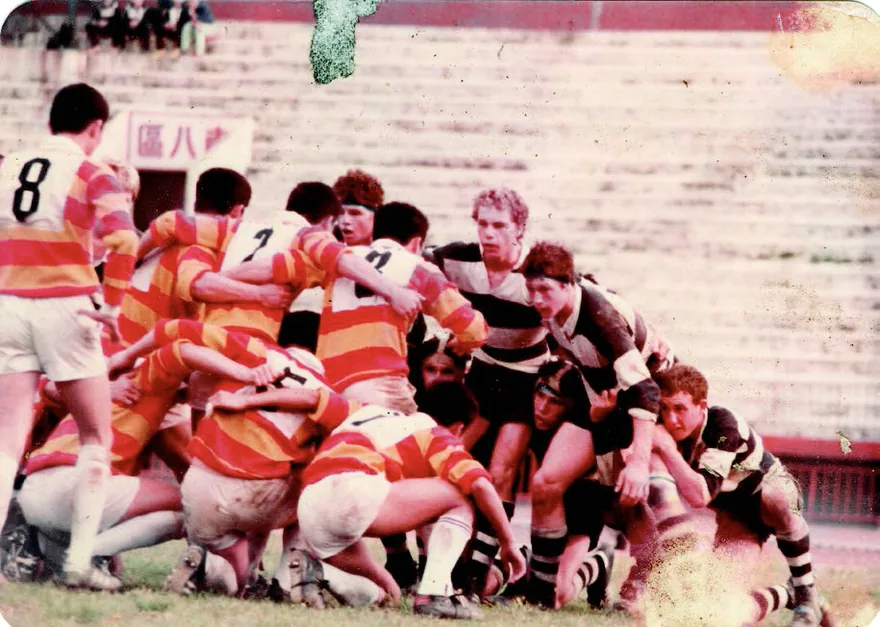
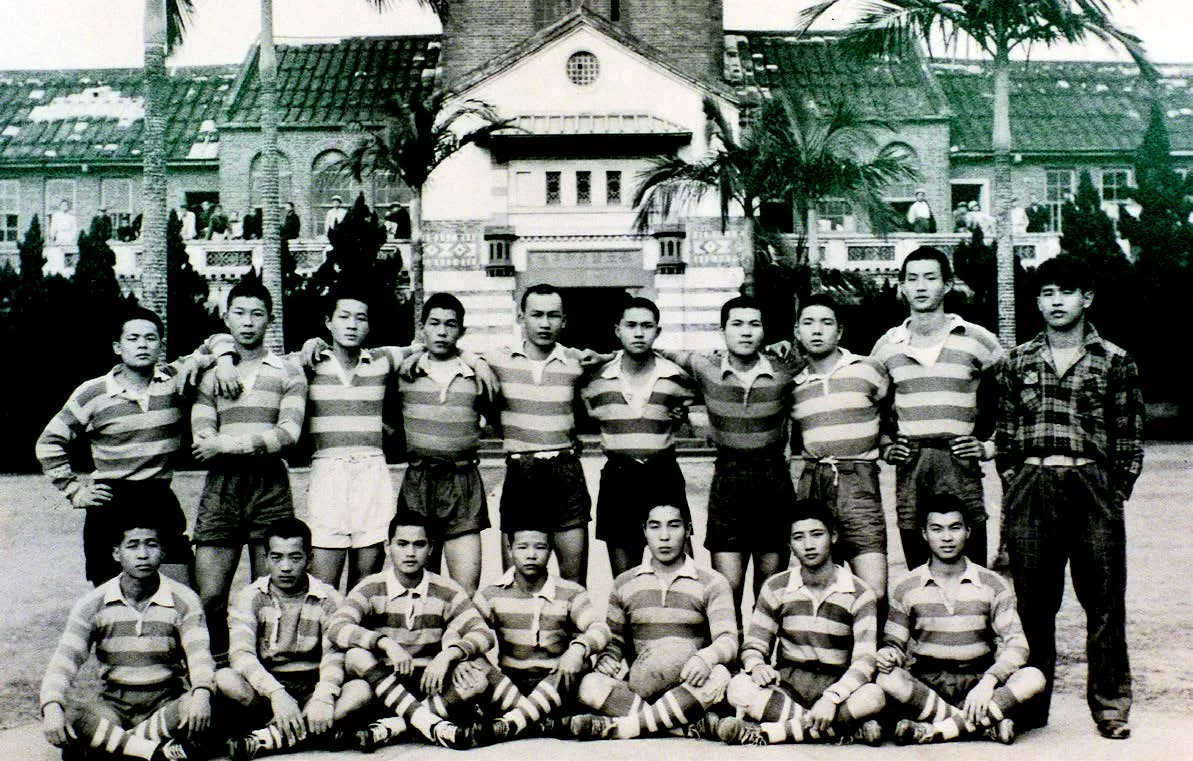
After the Second World War the Tamkang rugby team, quiet for a time, took the field again, and teams were formed one after another at schools in northern and southern Taiwan. In February 1968 Tamkang alumni formally founded the Tamkang Senior High School O.B. Rugby Club to help nurture and train the younger players of their old school and to keep the Tamkang rugby spirit alive. From then on the team flourished: besides winning prizes in competitions large and small at home and becoming a side known throughout Taiwan, it was several times selected as the national team, repeatedly achieving fine results and winning international renown. For nearly a century Tamkang Senior High School, on the fort hill at Puting in Tamsui, has worked hard for the game of rugby, and Tamsui has long since become an international centre of the sport.
In the Japanese period large sporting competitions were all held at the sports ground beside the museum in New Park, and the Tamsui Middle School team, representing the Taiwanese, was always the one the crowd cheered.
In June 1946 the Tamkang Senior High School rugby team returned to the field, opening the way for middle school rugby in postwar Taiwan. Above: the Tamkang Senior High School team winning the rugby title at the 4th Provincial Games in 1949; on the far left of the middle row is Principal Hsieh Hsi-te (謝禧得), then in his third year of junior high school.
In November 1927 Tamsui beat the strong Japanese side Taipei Higher Commercial School 14 to 0 at the New Park ground. Because Tamsui Middle School was not recognised by the Japanese authorities, and because mission schools were not allowed to play matches on Sundays, it never had the chance to display its strength in Japan.
The team of Chang Jung Senior High School, Tamkang Senior High School's sister school and a strong side from southern Taiwan, came north for a friendly match on the Tamkang Senior High School rugby ground.
Fifty years later, in 2013, Chang Jung Senior High School came to play at Tamkang again.
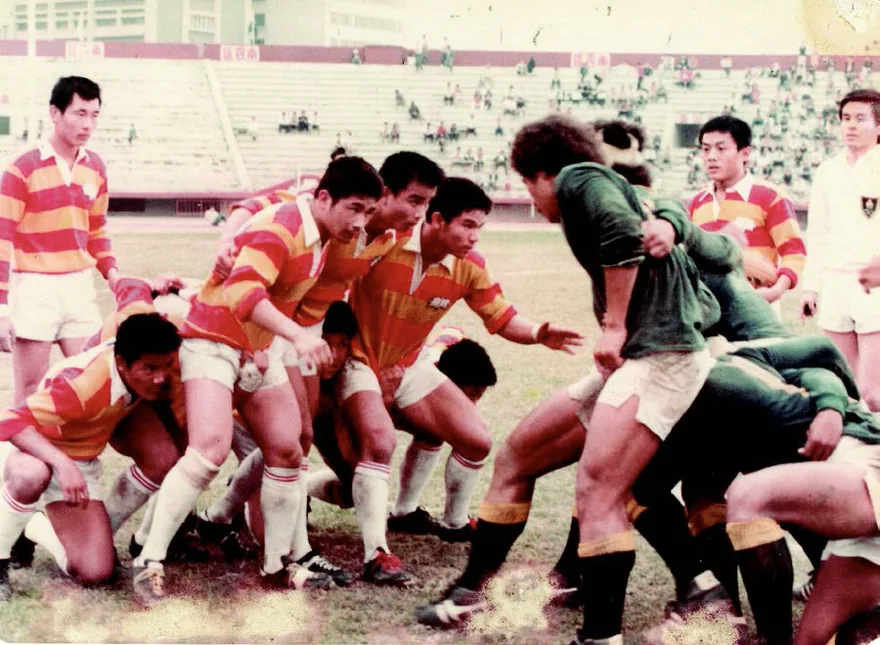
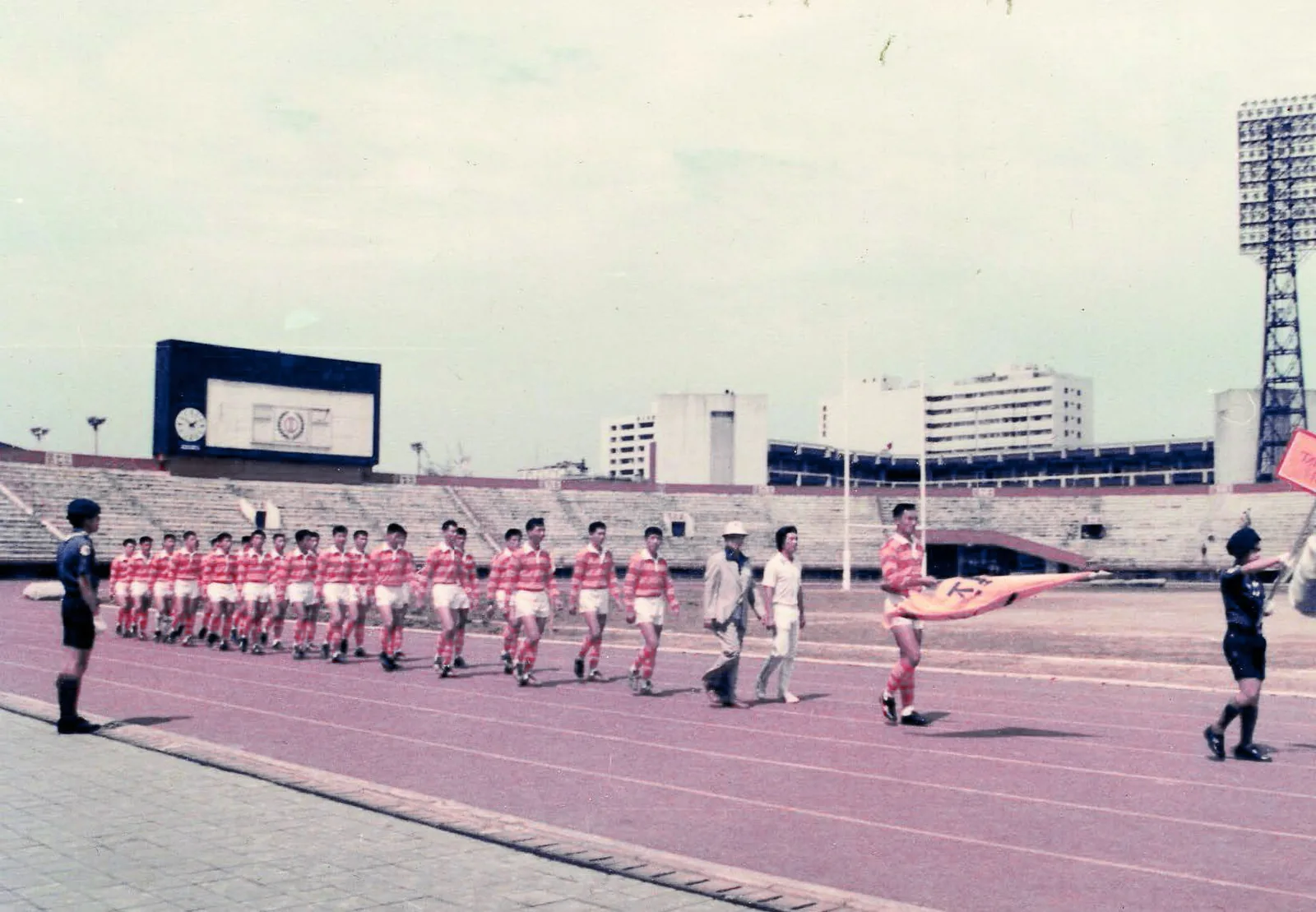
The Tamkang Senior High School team has several times been selected as the national team, with a distinguished record and a name known in the sporting world.
Winners of the Pan-Pacific Youth Rugby Championship in 1979
Champions of the 6th Asian Cup in 1981, winning international renown.
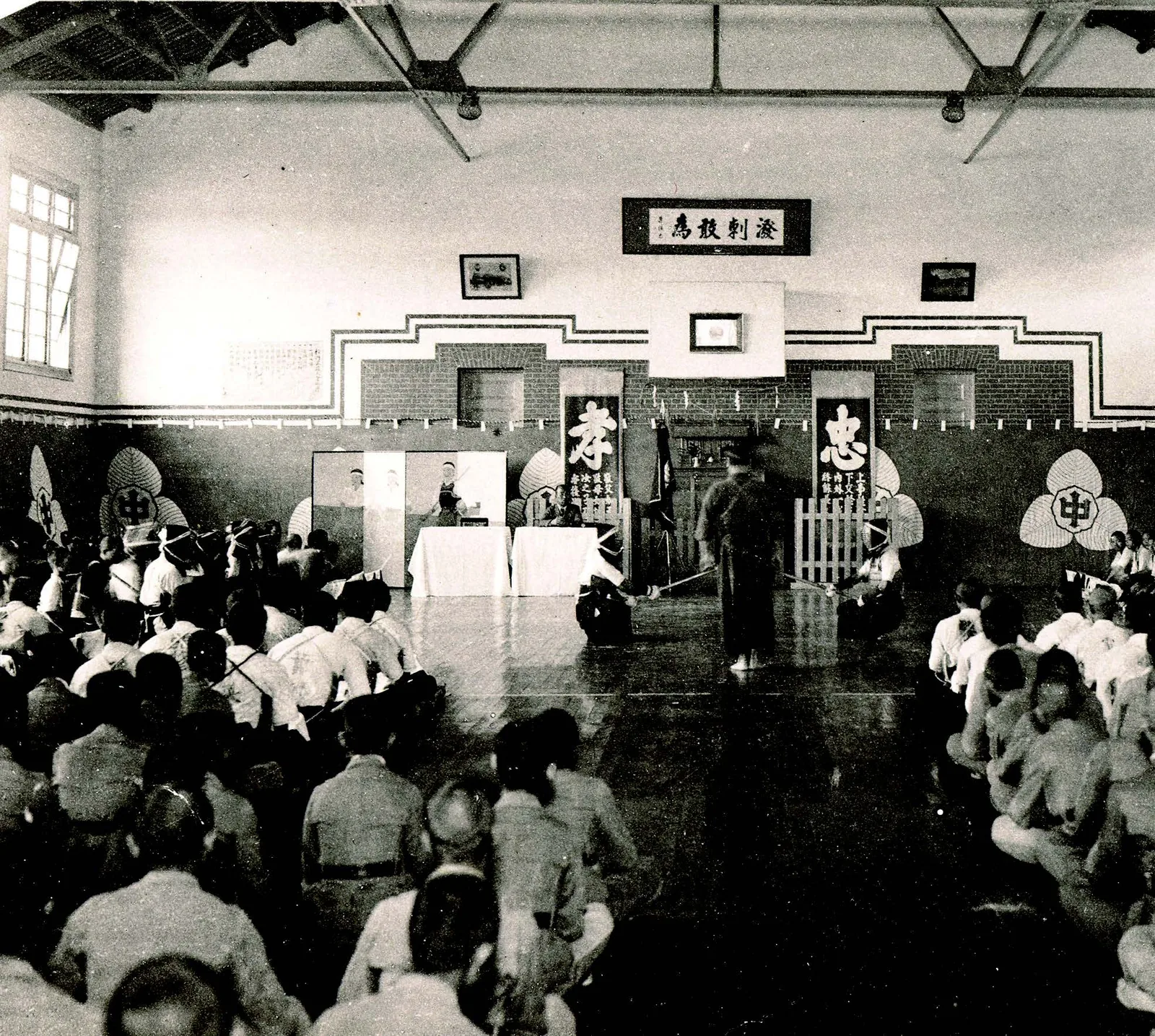
On the wall in the picture the four characters 「潑刺敢為」 (spirited and daring) were hung instead, and displayed in the centre is a rubbing of the stele of loyalty and filial piety of Wen Tianxiang, revered by Japanese warriors; the school badge with the Bible and the cross is no longer there.

After the Japanese took over Tamsui Middle School, the gymnasium changed greatly. It had been a place for physical education classes, religious worship, school activities and the church's major celebrations; the Japanese turned it into a solemn martial arts hall, a butokuden (武德殿) for the cultivation of martial virtue. On the wall in the picture the four characters 「潑刺敢為」 (spirited and daring) were hung instead, and displayed in the centre is a rubbing of the stele of loyalty and filial piety of Wen Tianxiang, revered by Japanese warriors; the school badge with the Bible and the cross is no longer there.